.png) 6 months ago
63
6 months ago
63

Upgrade to High-Speed Internet for only ₱1499/month!
Enjoy up to 100 Mbps fiber broadband, perfect for browsing, streaming, and gaming.
Visit Suniway.ph to learn
Financial market meltdown
MANILA, Philippines — Philippine financial markets were rocked by another wave of selling yesterday as the stock exchange suffered its steepest one-day drop in nearly six years, while the peso slumped to a fresh record low against the dollar amid surging oil prices and escalating tensions in the Middle East.
The benchmark Philippine Stock Exchange index (PSEi) barely survived finishing the session above the 6,000 level, plummeting by 4.97 percent or 314.19 points to end at 6,006.22.
Meanwhile, the peso depreciated by 50 centavos to 59.50 against the dollar yesterday from its 59 finish on Friday.
This was the PSEi’s biggest percentage drop in a single day since April 16, 2020, during the pandemic, when it lost 7.07 percent or 420.45 points.
The broader All Shares index also sank deep in the red, shedding 4.24 percent or 148.24 points to 3,346.75.
“Financial markets are now in full risk-off mode in the face of $100 (per barrel) oil and the prospect of a prolonged war in the Middle East,” China Bank Capital Corp. managing director Juan Paolo Colet said.
Philstocks Financial research manager Japhet Tantiangco said worries rose as the spike in oil prices and the depreciation of the peso are expected to pose upside risks to inflation.
“The local market started the week on a negative tone amid the surge in oil prices and the decline of the local currency due to the ongoing conflict between the US and Iran,” he said.
The bloodbath was seen across all sectors, with holding firms taking the biggest hit at 5.94 percent, followed by property, which plunged by 5.12 percent.
Trading was strong as total value turnover reached P11.08 billion.
Decliners battered advancers, 205 to 28, while 41 issues were unchanged.
ICTSI was the session’s top traded stock, sliding by 4.25 percent to P687.50 per share, followed by BDO and Metrobank, which tumbled by 3.84 percent and 5.31 percent, to P120.20 and P67.70, respectively.
Share prices of conglomerates SM Investments and Ayala fell by more than six percent each.
This is lower than the close recorded on Jan. 15, when the peso reached a previous low of 59.46 against the dollar.
During morning trade, the peso hit its worst level of the day at 59.71. Its strongest level reached 59.25 per dollar.
A trader said the peso’s sharp depreciation was largely driven by the sudden spike in global oil prices, adding that the exchange rate could test the 60-per-dollar level if pressures persist.
“The substantial depreciation of the peso was mainly attributed to the sudden spike in global oil prices today. It could be expected that the forex rate could be tested near the 60 level,” the trader said.
The trader added that possible intervention from the Bangko Sentral ng Pilipinas (BSP) cannot be ruled out if the peso approaches that level.
“Due to this sudden move in the peso from an external factor, any BSP intervention near the 60 level cannot be ruled out,” the trader said, noting that India’s central bank also stepped in when the rupee weakened to around 90 per dollar last week.
RCBC chief economist Michael Ricafort said the peso weakness came as global crude oil prices surged to their highest levels in nearly four years following escalating tensions in the Middle East.
“Global crude oil prices have surged to new highs in nearly four years amid the continued war on Iran since Feb. 28, raising risks of supply disruptions at the Strait of Hormuz where about 20 percent of global crude oil passes through,” Ricafort said.
He said that oil prices have climbed sharply in recent days, with Nymex crude trading above $102 per barrel, 12.5 percent higher than last Friday’s close of $90.90 per barrel. It marked the highest level of oil prices since July 2022.
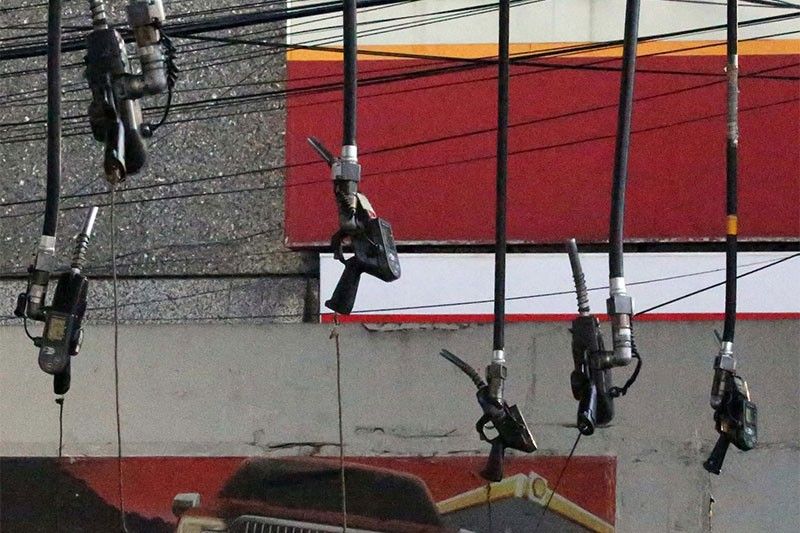
Higher oil prices could raise the Philippines’ import bill and widen the trade deficit, Ricafort said, while also triggering increases in local fuel pump prices, transport fares and other goods and services.
Ricafort expects the peso to move within the 59.35 to 59.60 range versus the greenback, following the latest record low.