
.png) 3 months ago
58
3 months ago
58

Upgrade to High-Speed Internet for only ₱1499/month!
Enjoy up to 100 Mbps fiber broadband, perfect for browsing, streaming, and gaming.
Visit Suniway.ph to learn
MANILA, Philippines — A very Filipino ingredient, ube (purple yam), is trending worldwide. Driven heavily by exposure from TikTok, ube is now experiencing a huge global surge, catapulting what was once a local Filipino ingredient that is sometimes used to impress on the global stage to what it is today — a mainstream viral sensation in Asia, America, and Europe.
Just like with Japan’s matcha and the Middle East’s pistachio kataifi, Philippine ube is now being used in almost everything — from lattes and milk teas and other iced beverages to breads, pastries, cakes, and unique desserts.
The transition, though, seems to be so sudden that it is stressing out Filipino ube farmers. From just enough supply to meet the country’s regular needs, the demand for Philippine ube is now so high (and still growing by leaps and bounds) that the struggle to keep up with it has become very real indeed.
The Philippines, it seems, is not ready for this, and yet the opportunity that presents itself for Philippine ube to be recognized as a major ingredient on a worldwide scale is too good to pass up.
This is exactly how Filipino chefs — especially long-time advocates of Filipino cuisine who long to see the day when Filipino cuisine would stand side by side with other internationally recognized cuisines — feel about it. While many are ecstatic about the development, they are at the same time concerned about the dwindling supply of ube that is available in the market.
What needs to be done?
Some of the metro’s top chefs share their thoughts about it.
Chef Sau Del Rosario
Café Fleur's Chef Sau Del Rosario is very proud and happy that ube is now a global sensation.
“I believe this marks one of the most thrilling culinary developments the Philippines has experienced in decades. For years, Japan popularized matcha, France embraced lavender, Mexico celebrated hibiscus, and the Middle East showcased pistachio. Now, with ube from the Philippines gaining recognition, the world is finally noticing that ube can be used as lattes, iced coffees, pastries, cheesecakes, cocktails, doughnuts, and breakfast treats. Then people have desire for natural, vibrant colors, and a search for new nostalgic ethnic flavors," Chef Sau said.
Though it is gaining ground in the international market, the chef is aware that supply does not meet demand in the case of Philippine ube.
“There are now multiple reports that Filipino farmers are struggling to keep pace with the sudden international craze, especially because ube is seasonal, slow growing, labor intensive, climate-sensitive, and often produced by small farms only,” said Chef Sau.
Among Chef Sau's signature dishes featuring ube is his Crispy Fried Ube Ravioli that is filled with coconut and jackfruit, topped with latik, and served with pandan sauce.
Chef Jessie Sincioco
Chef Jessie Sincioco is one proud Filipino chef who thinks it is about time a Filipino ingredients trends worldwide.
"Of course I am proud and happy because something really local and Filipino is invading the world’s food arena,” said.
Like Chef Sau, Chef Jessie is aware of the supply issue and is concerned about it.
“I am extremely concerned, though, that the country does not have enough supply of ube to meet the growing global demand. I am hoping we will be consistent in its production and focus on producing the best variety, work hard, and make sure that there will be steady and sufficient supply to go by,” she said.

Chef Jessie, who has been using ube for her restaurant and catering’s desserts, salads and even main entrées for years, believes the solution to the problem is in the hands of the government.
“I hope that farmers/growers will be able to get the much needed government support to attain and achieve the status of being the ube producer and supplier in the world,” she said.
Chef Pablo ‘Boy’ Logro
Chef Pablo ‘Boy’ Logro, who owns the distinction of being the first Filipino executive chef in the metro and has served in the palace kitchen of the King of Oman, is always ahead of his time.
This time, while most chefs are simply reacting to the sudden rise in global popularity of Philippine ube, he is already laying the groundwork to make ube a viable source of livelihood for Filipino farmers.
“The whole world now recognizes that Philippine ube has great potential, but the problem is that we are now running out of supply nationwide. Ube production is also emerging as an income generator, especially now that new technology enables easier ways to process the tuber, including peeling off their skin so they can easily be used to make cream, juice or powder that are essential in making cakes and pastries,” Chef Boy explained.
He added, “The remedy is for government to teach, support our local farmers, and help them achieve a steady and stable ube production and market their products afterwards. If government does this, our farmers have the potential of earning big money in just eight to nine months or even a year of crop production.”

Sebastian's Ube Ice Cream
Personally, Chef Boy has already started serious ube production in his farm. He has also already gathered the farmers in his home province of Cavite and encouraged them to plant more ube because he will be the sure buyer of their produce. He has set up a factory for this. He has named it Logro Food Processing and Manufacturing.
“If the government seriously helps ube farmers by providing them with new technology and necessary equipment, either at no cost or by way of a reasonable payment scheme, then ube farmers are bound to succeed in their quest to provide enough supply for the steadily growing demand for Philippine ube," the chef said.
Chef Rhea Castro Sycip
If there is one person who truly knows her ube, it is Chef Rhea Casto SyCip because she uses a lot of the root crop in her bakeshop and café, Flour Pot PH.
Ube, after all, is a classic flavor that most bakers offer in their cakes, breads, ensaymadas, and other pastries. Even drinks and desserts come in ube flavor variants.
Flour Pot, in particular, always comes up with a batch of its Ube Kinampay Cake during the first quarter of the year, with Chef Rhea using up the total amount of Ube Kinampay supplied to her by farmers of this premium variety of ube in Bohol.
Hailed as the Queen of Philippine Yams, this high-value and “almost sacred” crop usually harvested from November to January is native to Bohol, and Chef Rhea “discovered” it when he and husband Chef JayJay SyCip briefly lived in Bohol a few years back.
“Bohol grows at least seven varieties of ube, and each town is proud of its tuber: Kinampay, Binanag, Baligunhon, Iniling, Kabus, Tamisan, and Binato. Ube is sacred to Boholanos, as it became their primary food source during the Japanese war, as shared to us by Bohol’s historian, the late Marianito Luspo. Some varieties are meant to be cooked as desserts like Halaya, some cooked as stews, and some as fritters,” the chef said.
She added that Ube, being a seasonal crop, will have a problem meeting a growing demand for it. Even before the worldwide ube craze began, quality ube was already getting more difficult to source.
“Deep purple colored and sticky varieties, which used to be so easy to look for, now needs help sourcing from farmers’ networks,” she said. “I am currently using a variety from Bohol — fragrant, sticky, natural purple in color — an annual crop so rare now that it costs me P700 a kilo.”

Bakers' Champ's Puto Bumbong Croissant
While she is happy that Philippine ube now gets the attention it deserves and credit is properly being given to the Philippines for it, Chef Rhea is also concerned that ube flavoring might be used recklessly, so much so that it will no longer represent the real taste and color of natural ube. But she keeps her spirit high.
“I am hopeful that with this demand, more of our farmers will see its value and plant ube. That can be the start of an ube farming revolution,” she ended.
Chef Jackie Ang Po
Celebrity chef Jackie Ang Po, who is a much sought-after recipe developer for food manufacturing companies, agrees that it is about time the Philippine ube is given the recognition it deserves now that it is trending in the international food scene. She isn’t too worried, either, that the country would not be able to adequately supply the growing demand for ube.
She looks at the situation as a blessing and a challenge.
“The challenge,” she said, “is for our ube farmers and ube powder manufacturers to take advantage of the growing demand for Philippine ube, because if they don’t, another country will.”
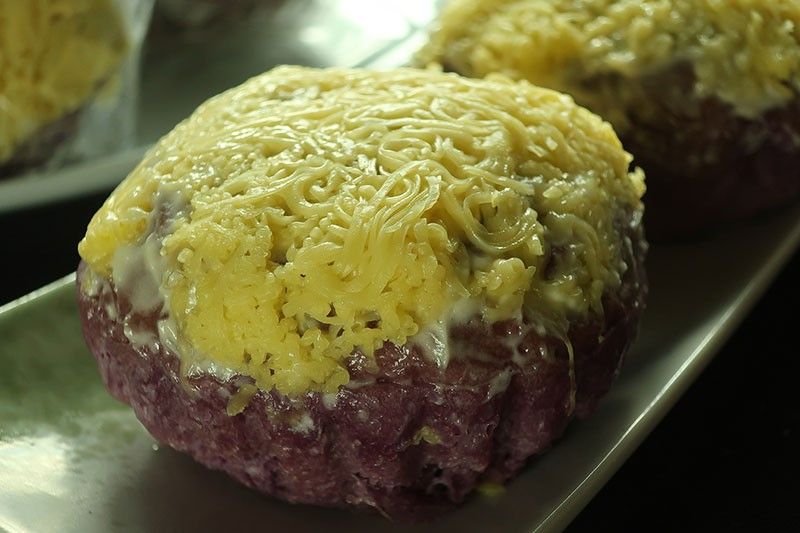
RobinCakes Mnl's Ube Ensaymada


