 2 months ago
54
2 months ago
54

Upgrade to High-Speed Internet for only ₱1499/month!
Enjoy up to 100 Mbps fiber broadband, perfect for browsing, streaming, and gaming.
Visit Suniway.ph to learn
Behind every successful infrastructure company lies one defining test: can management consistently turn billions of pesos of capital into durable shareholder returns? That question is at the heart of the GSIS’ investment in Citicore.
The easiest way to misunderstand Citicore Renewable Energy Corp. is to judge it like a power company. It is not, at least not yet.
Today, Citicore is better understood as a capital allocation enterprise, deploying billions of pesos to assemble an energy platform whose real value will emerge only years from now.
That distinction explains why the acquisition by the Government Service Insurance System (GSIS) of a 7.5% stake deserves neither automatic applause nor unwarranted skepticism. GSIS is not simply buying solar farms. It is investing in the ability of Citicore’s management’s to transform massive capital spending into future cash flows that exceed the cost of that capital.
 Screenshot of Citicore Renewable Energy Corporation’s disclosure to the Philippine Stock Exchange on July 3, 2026.
 Infrastructure investing has always rewarded those who distinguish between construction and value creation. Airports, toll roads, and power plants demand enormous investment long before they generate meaningful returns.
During that period, assets expand, borrowings climb, equity is raised, and cash is consumed ahead of earnings. Investors who focus only on current profits often miss the larger story. What ultimately matters is whether management earns returns that exceed the capital employed to build those assets.
Citicore’s financial profile reflects a company firmly in that investment phase. Based on its audited parent-company financial statements, total assets increased from P28.1 billion in 2024 to P40.6 billion in 2025, a 44% expansion in a single year. Equity rose from P4.8 billion to P21.9 billion, supported by roughly P6.7 billion in fresh capital, while total borrowings climbed to approximately P14.6 billion. These figures portray a company aggressively deploying resources rather than maximizing near-term profitability.
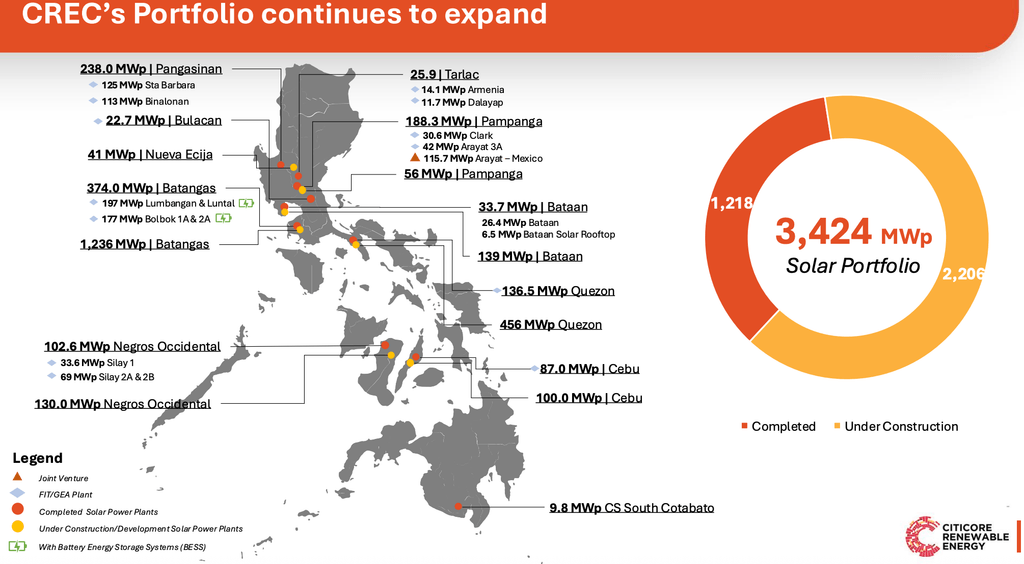 Citicore Renewable Energy Corp. 1Q 2026 Analyst Briefing Presentation, May 15, 2026
The financing pattern is equally revealing. During the year, the parent generated only about P125.5 million in operating cash while deploying more than P10 billion into investments in subsidiaries, property additions, and advances within the corporate group. Internally generated cash therefore financed only a small fraction of the expansion program, with the balance coming from lenders and shareholders. That is hardly unusual in infrastructure. What is vital to consider is whether today’s investments ultimately generate returns that justify the capital committed.
There are already signs the strategy is beginning to work. In the first quarter of 2026, CREC increased net income 58% to P364 million while EBITDA rose 53% to P593 million, driven largely by electricity sales from an expanding portfolio of operating assets. Those results suggest that investments made during the company’s build-out phase are beginning to translate into operating profitability.
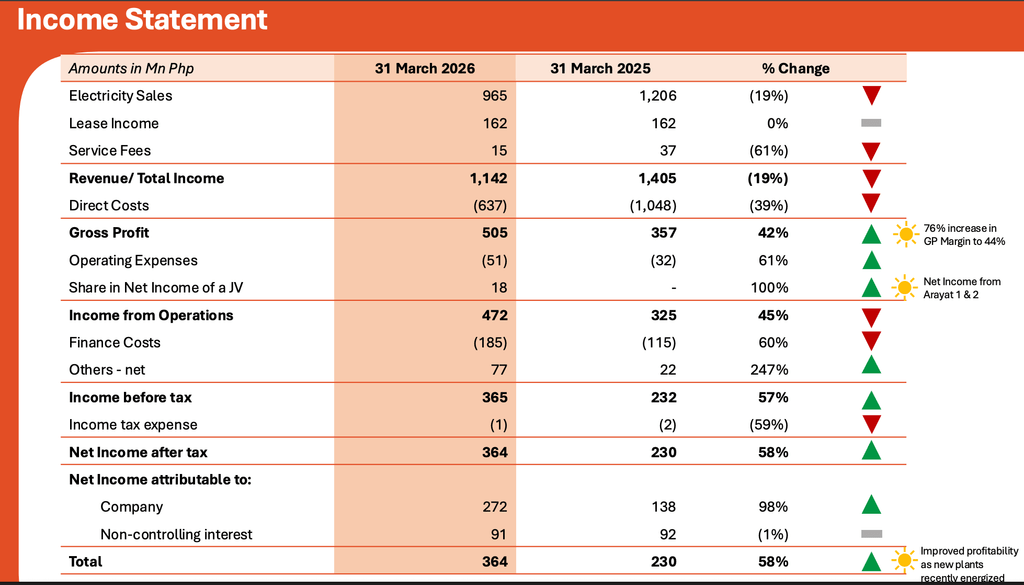 Citicore Renewable Energy Corp. 1Q 2026 Analyst Briefing Presentation, May 15, 2026
One strong quarter, however, does not eliminate execution risk. The real test is whether those earnings evolve into durable operating cash flows that can finance future expansion with progressively less reliance on external capital.
Understanding Citicore also requires understanding CREIT (Citicore Energy REIT Corp.), the country’s first renewable energy real estate investment trust. Although both belong to the same ecosystem, they perform very different functions. CREIT owns renewable-energy real estate and earns recurring lease income from long-term contracts, providing stable cash flows and dividends. Citicore Renewable Energy develops, finances, constructs, and operates renewable-energy projects. One owns mature assets. The other creates them.
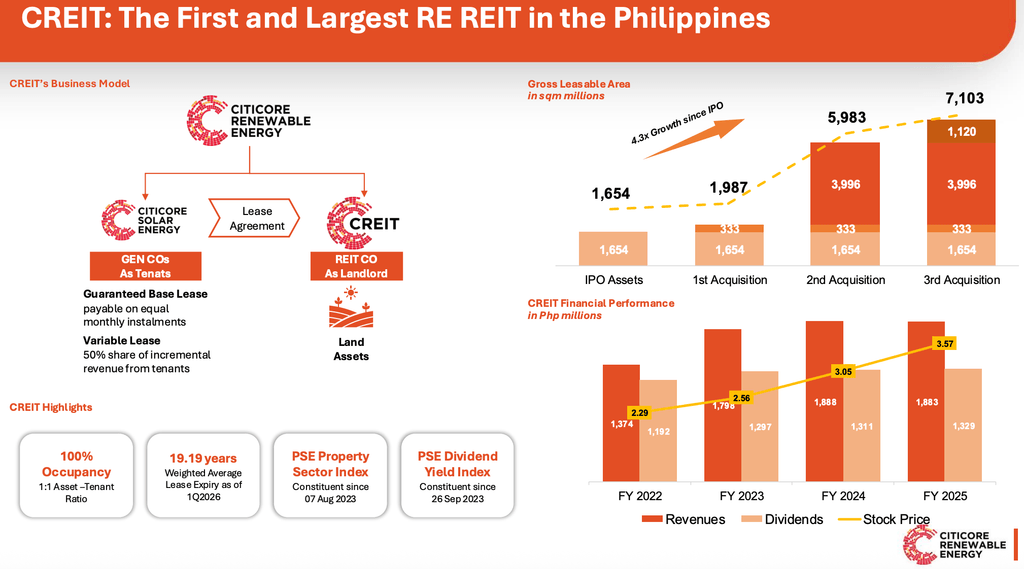 Citicore Renewable Energy Corp. 1Q 2026 Analyst Briefing Presentation, May 15, 2026
That relationship could become Citicore’s greatest strategic advantage. Rather than permanently retaining every completed asset, mature renewable properties can eventually be monetized through CREIT, allowing capital to be recycled into the next generation of projects.
Global infrastructure investors, such as Brookfield Asset Management, Macquarie Group, and Blackstone Inc., have long relied on similar models to sustain growth while reducing dependence on continual debt and equity raising. If executed well, CREIT becomes more than a landlord. It becomes another source of capital for expansion.
Viewed through that lens, Citicore is not merely constructing solar farms. It is assembling an integrated infrastructure platform in which development, operations, and real estate ownership reinforce one another. The strategy is financially logical. Whether it becomes financially rewarding depends almost entirely on execution.
That remains the principal investment risk. Infrastructure history is filled with companies that built impressive asset portfolios but failed to create shareholder value because projects exceeded budgets, financing costs rose, or capital was allocated inefficiently. Renewable energy is no exception. Every peso borrowed must earn more than its financing cost, while every peso entrusted by shareholders must create value beyond simply enlarging the balance sheet.
One item deserves continued monitoring. Advances to related parties totaled about P5.8 billion, representing a meaningful portion of total assets. Such balances are common among infrastructure groups operating through multiple subsidiaries and project companies, and they do not by themselves suggest governance concerns. They do, however, highlight the importance of understanding how capital circulates within the broader Citicore ecosystem and whether those allocations consistently improve long-term returns.
Investors should likewise avoid reading too much into the parent company’s year-on-year earnings decline. The comparison was heavily affected by unusually large one-off gains and dividend income recognized in 2024. The more meaningful measure is not accounting profit but whether today’s investments mature into durable operating cash flows.
That is why I believe the question to be asked is not whether GSIS made the right investment. It is far too early to answer that. The better question is whether Citicore’s management can consistently deploy billions of pesos into projects that earn returns above their cost of capital while using CREIT’s capital-recycling platform to finance the next wave of growth.
If management succeeds, GSIS will own more than shares in another renewable-energy company. It will own a stake in a sophisticated infrastructure platform capable of compounding value for decades. If management falls short, rapid balance-sheet expansion will become little more than an expensive accumulation of assets without commensurate shareholder returns.
Years from now, this investment will not be judged by the number of solar panels installed or the gigawatts connected to the grid. It will be judged by a far simpler measure: whether the billions of pesos deployed today produce durable cash flows and superior returns tomorrow. That is the wager GSIS has made. – Rappler.com
Below are Vantage Point articles you may have missed:
Click here for other Vantage Point articles.