.png) 1 week ago
18
1 week ago
18

Upgrade to High-Speed Internet for only ₱1499/month!
Enjoy up to 100 Mbps fiber broadband, perfect for browsing, streaming, and gaming.
Visit Suniway.ph to learn
The benchmark Philippine Stock Exchange index snapped its three-day winning streak after shedding 0.72 percent or 44.16 points to close at 6,054.05.
Pixabay / File
MANILA, Philippines — The local stock market plunged in the red while the peso tumbled back to the 60 to $1 level as renewed tensions in the Middle East intensified selling pressure.
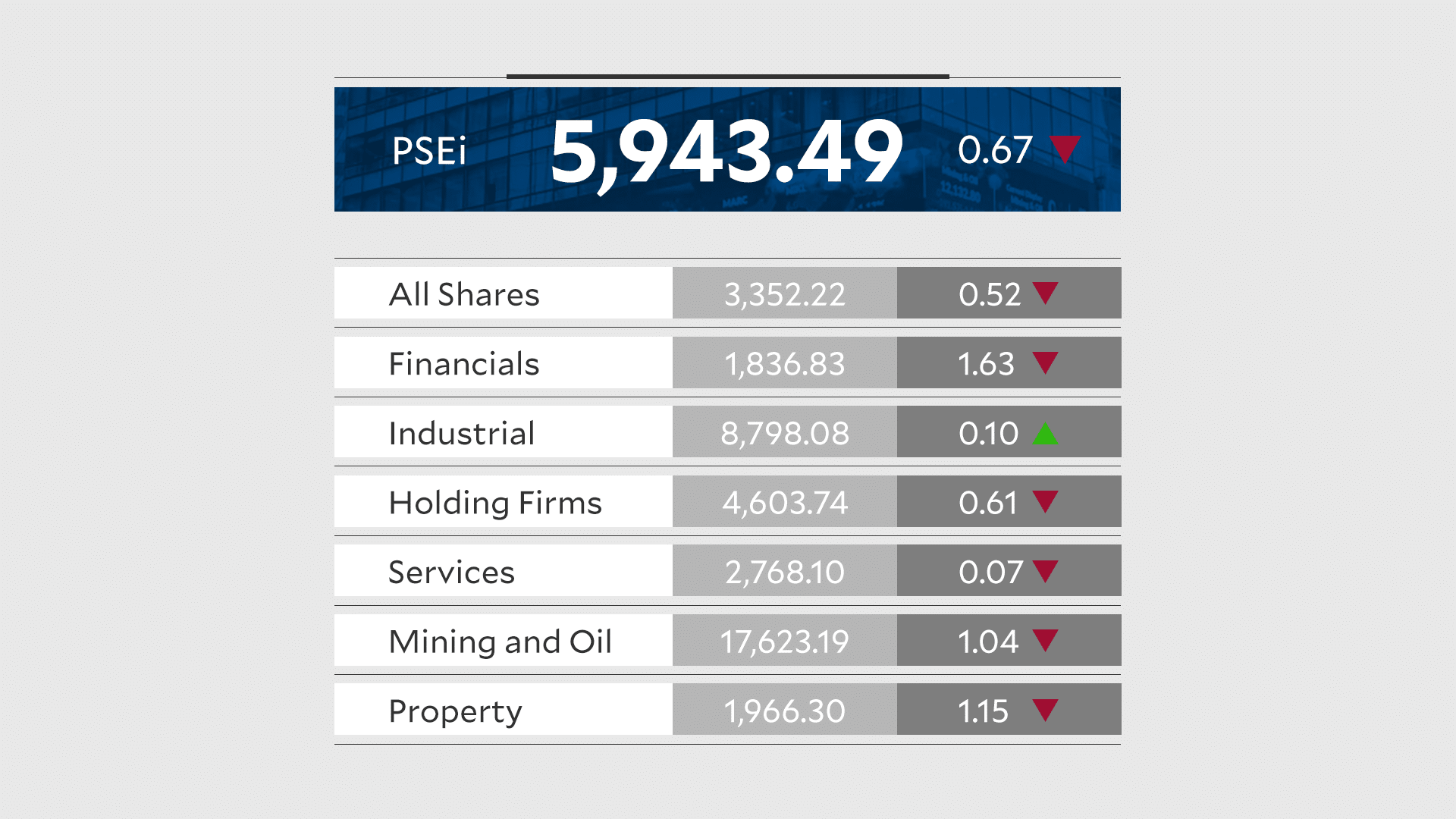
The benchmark Philippine Stock Exchange index snapped its three-day winning streak after shedding 0.72 percent or 44.16 points to close at 6,054.05.
The broader All Shares index also declined by 0.65 percent or 22.01 points, ending the session at 3,386.52.
“Philippine equities closed in the red as renewed geopolitical tensions in the Middle East dampened investor sentiment,” Luis Limlingan of Regina Capital said.
“Concerns escalated after Donald Trump threatened Iran a blockade of the Strait of Hormuz, reigniting fears of supply disruptions and a spike in global oil prices. Crude has already surged above $100 per barrel following the announcement, raising inflation risks and weighing on risk assets globally,” Limlingan said.
All sectors were in negative territory, except for services which rose by 1.02 percent.
Financials index was the biggest loser, plunging by 2.35 percent, followed by property which dropped by 1.54 percent.
Total turnover value opened the week at P7.8 billion.
Decliners hammered advancers, 121 to 82, while 69 issues were unchanged.
ICTSI was the session’s top traded stock, bucking the downtrend with a 1.94-percent gain to P734 per share.
Meanwhile, data from the Bankers Association of the Philippines showed the peso closed at 60.135 per dollar, weaker by about 16.5 centavos from Friday’s 59.97 finish.
The local currency opened at 60.25 and traded between a high of 60.50 and a low of 60.13 during the session. Trading volume rose by 26.8 percent to $1.89 billion from $1.49 billion on Friday.
The return to the 60 level reflects renewed demand for the dollar amid lingering global uncertainties, including elevated oil prices and geopolitical risks, which have continued to pressure emerging market currencies.