.png) 5 months ago
112
5 months ago
112

Upgrade to High-Speed Internet for only ₱1499/month!
Enjoy up to 100 Mbps fiber broadband, perfect for browsing, streaming, and gaming.
Visit Suniway.ph to learn
“We learn in difficulty because an easy, comfortable life is a very bad teacher.”
It was Archbishop Socrates Villegas who said it during the funeral of Jose de Venecia Jr., framing a life shaped as much by adversity as by achievement. In the same breath, he offered a metaphor that has since endured:
“He’s our bangus… our gift.”
Forty days later, that image remains.

A meaningful tribute on JDV’s 40th day — his family receives a special book from the House of Representatives, a compilation of heartfelt eulogies and cherished moments from his necrological service in Congress.
Recently, family, friends, and colleagues gathered at the Libingan ng mga Bayani to mark the 40th day since the passing of the country’s longest-serving Speaker of the House. A Mass was held, followed by a simple program; quiet, reflective, and fitting for a man whose public life was defined less by spectacle than by steady institution-building.
The bangus metaphor -- humble, resilient, able to survive in different waters -- has proven to be more than symbolic. It has become a lens through which to understand JDV’s leadership.
“Thank you for life’s thorns,” Archbishop Villegas said then, “because they have become our lessons.”
Those who worked with him would recognize that immediately. JDV’s career spanned business, diplomacy, and politics. He navigated crises, built coalitions, and anchored reforms. Not through force, but through persistence and negotiation.

Architect Dan Lichauco presents the design for JDV’s tomb, soon to be completed with a bust honoring the five-time Speaker’s enduring legacy.
‘Rainbow Joe’
As former Speaker Feliciano Belmonte Jr. recalled, his tenure “was defined by his relentless pursuit for unity,” underscored by a belief that “through collaboration and dialogue, we could rise above our differences.” That approach found its clearest expression in the “Rainbow Coalition,” a governing model that turned political fragmentation into working consensus. It was not merely a tactical arrangement but a governing philosophy.
The 40th day observance also turned attention to how that philosophy will be remembered, when Architect Dan Lichauco presented the design of JDV’s tomb.
At its center are eight ascending travertine pylons, symbolizing the eight rays of the Philippine flag. Their gradual rise toward a cross reflects a lifetime of public service culminating in a higher calling. Beneath them, a flag-shaped tomb carved in black granite anchors the monument, an explicit reference to a life “wrapped in service to the Republic.” At the base, a more personal detail: bangus-shaped benches. A bust of JDV will complete the site.
During the program, a digital tribute was also presented, a compilation of archival footage, photographs, and narrative elements. It was my personal project, my labor of love, to preserve and extend JDV’s story for a wider audience.
No single piece can capture the full scope of his career. But as with the monument, the intent is continuity: to ensure that his ideas, particularly his emphasis on dialogue and consensus, remain accessible to future generations. Watch it here:

Left: A cherished family photo with JDV and Manay Gina during his 89th birthday; Right: An autographed photo of JDV—one of my earliest mentors, alongside Manay Gina, right after I graduated.
Farewell, Ninong Joe
Fresh out of college, I worked for JDV and Ninang Gina --- two figures who would later loom large in our political history, but who, to me, were simply my first mentors. They shaped the way I understood leadership long before I fully grasped what public service required.
Close to three decades later, I saw him again. Dementia had taken much. Words no longer came easily. When I approached him during his 89th birthday, Ninang Gina gently reminded him who I was. For a brief moment, clarity broke through.
“Ikaw ang magaling na Castañeda.” I smiled then. I hold on to it now.
Across the eulogies, one theme emerged--not dominance, but dialogue.
Manay Gina spoke of a man who believed that “peace and prosperity must walk hand in hand,” and who would often remind her: “no achievement is ever ours alone.”
His son, Christopher de Venecia, offered a more personal reflection: that his father felt like “a public good –- non-excludable, non-rival.”
Stepdaughter Carissa Cruz Evangelista spoke of a man who made people believe in possibilities, “one person… could make a difference… you just needed to find others who believed in the same vision,” JDV would tell her.
Former congressman Conrad Estrella III recalled a defining lesson: “Huwag kang magtanim ng galit… ikaw lang ang mahihirapan.”

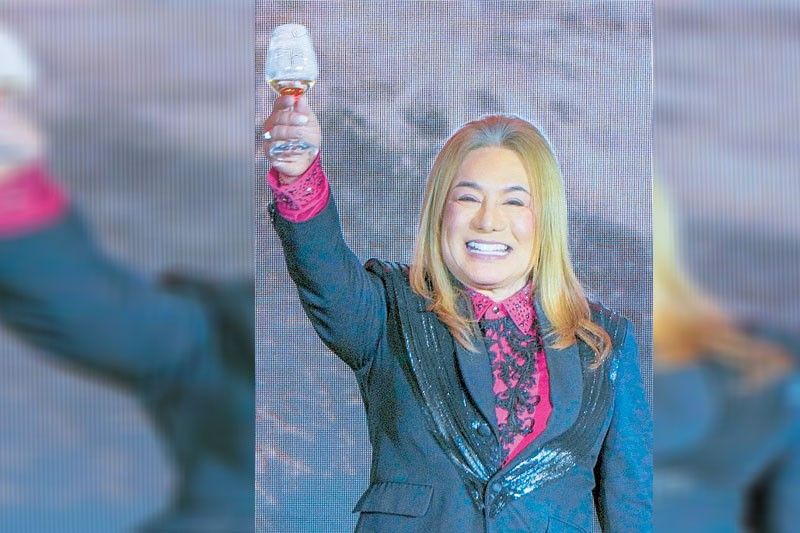
(L-R: Former Cong. Lorna Silverio, Former Sen. Cynthia Villar, Manay Gina de Venecia, ?Cong. Linabelle Villarica, Malou de Venecia and Joey de Venecia at the 40th day mass at the Libingan ng mga Bayani)
It is tempting in moments like this to measure a man by his titles. Five-time House speaker, statesman, diplomat. Builder of institutions. And partner in governance alongside leaders like former President Gloria Macapagal Arroyo. She described JDV as a “parliamentarian, statesman, peacemaker.” A leader whose business acumen shaped his political decisiveness, and whose vision extended beyond borders through institutions like the ASEAN Inter-Parliamentary Assembly (AIPA).
JDV operated within a political environment that was no less complex than today’s. Yet his response was consistent: build consensus, maintain dialogue, and treat institutions as the primary arena of governance.
A legacy of harmony
In today’s politics -- louder, faster, more divided-- that kind of leadership feels almost foreign. We have grown accustomed to spectacle over substance. To division over dialogue, to winning over understanding. Manong Joe stood for something else: politics where adversaries could still speak without shouting. In practical terms, he made governance work.
To those who prayed over him in his final farewell, led by Congresswoman Linabelle Villarica, he was a man whose life proved that “consensus-building stabilized the legislature,” and whose example calls others to “bring down divisions.”

Family and friends gather in remembrance of JDV, honoring a life that touched so many.
Forty days on, the public rituals of mourning begin to give way to longer-term questions of memory and legacy.
And so perhaps the Archbishop was right: perhaps bangus is the perfect metaphor after all. Because in a sea that is often rough and unforgiving, it is not always the fiercest that endure, but the ones who adapt, who persist, who quietly hold their ground.
“The resilience that is Joe de Venecia,” Archbishop Soc said, “is now part of our history.”
I think back now to that final moment. It may be a fleeting recognition. A very simple line that, at the time, felt small, but now feels like a gift.
In the end, perhaps legacy is not in the grand speeches or the sweeping reforms, but in the lives we touched, the people we shaped, the bridges we built.
Rest well, Ninong Joe. Your mission is done. And in a time when politics struggles to listen, may we remember the man who never stopped trying.
--
Follow my social media accounts JingCastaneda: Instagram, Facebook, YouTube, Tiktok and Twitter. Send your questions, suggestions and reactions to [email protected].