.png) 5 hours ago
1
5 hours ago
1

Upgrade to High-Speed Internet for only ₱1499/month!
Enjoy up to 100 Mbps fiber broadband, perfect for browsing, streaming, and gaming.
Visit Suniway.ph to learn
September 28, 2026 | 12:00am
The stock market has always rewarded winners. But today, the winners are so large that they make up the bulk of the stock index.
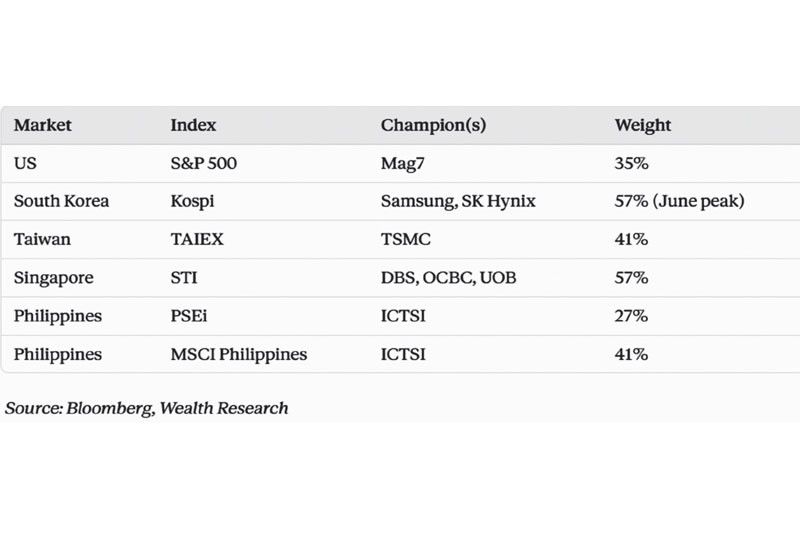
In the US, the Magnificent Seven (Nvidia, Apple, Microsoft, Alphabet, Amazon, Meta and Tesla) account for about 35 percent of the S&P 500. That means that only seven companies make up more than a third of the index, while the remaining 493 companies share the other 65 percent. The top 20 companies account for about 50 percent, while the top 40 make up about 60 percent of the entire index.
It is even more lopsided in Asia. Taiwan Semiconductor Manufacturing Co. (TSMC) accounts for more than 40 percent of the TAIEX. Samsung Electronics and SK Hynix together make up more than half of the KOSPI. In Singapore, three banks (DBS, OCBC and UOB) account for about 57 percent of the Straits Times Index. Here at home, ICTSI has grown to 27 percent of the PSE Index and 44 percent of MSCI Philippines.
Size becomes an advantage
Size itself has become an advantage for the bigger companies. In AI, the largest tech companies, or hyperscalers, are spending more than $700 billion on data centers, chips, models and talent. TSMC is spending about $54 billion to build more advanced chip plants. In Korea, SK Hynix announced a KRW100 trillion ($64 billion) investment program, while Samsung is also expanding high-bandwidth memory (HBM) capacity. Smaller competitors do not have the balance sheets to match this level of spending.
ICTSI also uses its growing cash flows and strong balance sheet to acquire and develop ports around the world. It now operates 34 ports in 19 countries across six continents. New terminals add to its earnings and give it the capacity to fund further acquisitions.
Passive investing adds fuel
Index funds add to the trend. They buy every stock in the index according to its index weight. Take the PSEi, for example. With ICTSI at about 27 percent of the index, every P100 invested in a PSEi fund puts P27 into ICTSI. The same is true for SPY, QQQ, EWY, EWT, EWS and EPHE, where most of the money goes to the largest stocks in each market.
A similar effect is happening globally. The US now accounts for about 70 percent of the MSCI All Country World Index, the benchmark for global equities.
As US stocks outperformed, driven by their premier position in the AI revolution, US market capitalization grew and the country’s weight in the global index increased as well.
The small gets smaller, cheap becomes cheaper
The reverse happens to companies whose stock prices fall behind. When a stock underperforms, its market cap and index weight decline. Eventually, if its free-float market value or trading liquidity drops below thresholds, the stock may be downgraded to a small-cap index or removed altogether.
Major index providers such as MSCI and FTSE Russell do not consider valuation or management quality. A well-run company trading at a low valuation can still lose its place in the benchmark if it becomes too small or too thinly traded. That is why cheap can become cheaper. Lower prices shrink market cap, reduce index weight and can eventually trigger forced selling by passive funds.
Meanwhile, the biggest stocks and the biggest markets keep attracting a larger share of benchmark-driven flows. This also helps explain why money keeps gravitating toward the US stock market. Index providers favor size, not cheapness. On the other hand, persistently low valuations and low liquidity have pushed a record number of companies worldwide to go private and delist.
Blue chips lose their place
In the Philippines, Jollibee Foods Corp. and Ayala Land – two of the most admired and revered Philippine companies – were removed from the MSCI Philippines Index this year after their market values and liquidity fell below thresholds.
At its peak, the MSCI Philippines Index had 23 constituents and Philippine stocks accounted for about 1.47 percent of the MSCI Emerging Markets Index (EEM). Today, the index is down to just nine stocks and the country’s weight in EEM has fallen to about 0.29 percent.
When a stock is removed, passive funds tracking the index are forced to sell it. Active managers often trim their holdings as well.
The Philippine effect
The impact of this index-driven phenomenon is notably pronounced in the Philippine market. Average daily value turnover on the PSE was only P7.7 billion (about $125 million) in the first half of 2026. This month, it has fallen to about P6 billion (less than $100 million) a day. Many Philippine companies trade at steep discounts to their historical valuations. But without size and liquidity, low valuations have not been enough to bring buyers back.
For now, size and scale win. The largest companies can invest more, make acquisitions and raise capital more easily. Rising share prices lift their index weights and bring in more passive money. Smaller companies move in the opposite direction, and some end up outside the benchmark altogether. Size begets size.
Philequity Management is the fund manager of the leading mutual funds in the Philippines. Visit www.philequity.net to learn more about Philequity’s managed funds or to view previous articles. For inquiries or to send feedback, please call (02) 8250-8700 or email [email protected].