 1 hour ago
6
1 hour ago
6

Upgrade to High-Speed Internet for only ₱1499/month!
Enjoy up to 100 Mbps fiber broadband, perfect for browsing, streaming, and gaming.
Visit Suniway.ph to learn
MANILA, Philippines — Several classrooms at Masantol High School in Pampanga are not the size they used to be.
Long before Willet Perez became principal five years ago, her predecessors had already begun elevating the floors to keep them above the floodwaters from the nearby Pampanga River. Each round of elevation cost about P50,000 to P100,000 and brought three years of relief before the floodwaters catch up again.
By the time Perez took over, some rooms had been raised enough times that an adult could reach up and touch the ceiling. The low ceilings trap heat and choke off ventilation for students and teachers.
“The running joke here is that they look like hobbit houses,” said Perez, whose regular five-year tenure as principal of Masantol ended earlier this year.

Willet Sunga Perez, former school head and teacher of Masantol High School in Pampanga, shows the classrooms on campus, including one retrofitted with raised flooring to cope with floodwaters that regularly inundate the grounds, March 11, 2026.
Philstar.com / Efigenio Toledo IV
Masantol's squat rooms are an extreme symptom of a problem that is costing the government tens of billions of pesos.
The nationwide cost of repairing classrooms wrecked by storms, earthquakes and floods has more than quadrupled in two years — from P8.76 billion in 2023 to P38.11 billion in 2025, or about $142 million to $618 million, according to DepEd records shared with Philstar.com. Super Typhoon Uwan (international name: Fung-wong) accounted for nearly a third of the 2025 total on its own.
Across the Philippines, principals in disaster-prone areas spend as much time scrounging up funds for repairs and improvising solutions to campus flooding as they do running the school. While DepEd has already found an elevated school building design, Secretary Sonny Angara has acknowledged that its immediate nationwide rollout would be too costly at this time.
DepEd's own budgeting for damaged buildings assumes that all classrooms still follow the standard design. When a classroom is “totally destroyed” — one of three classifications DepEd uses — the department budgets a flat P2.5 million (about $40,500) to rebuild it. Meanwhile, it estimates P500,000 ($8,100) for major repairs and P49,000 for minor repairs ($794) — regardless if a room is a standard unit, or one of Masantol's low-ceiling rooms that do not follow standard dimensions due to repeated adjustments.
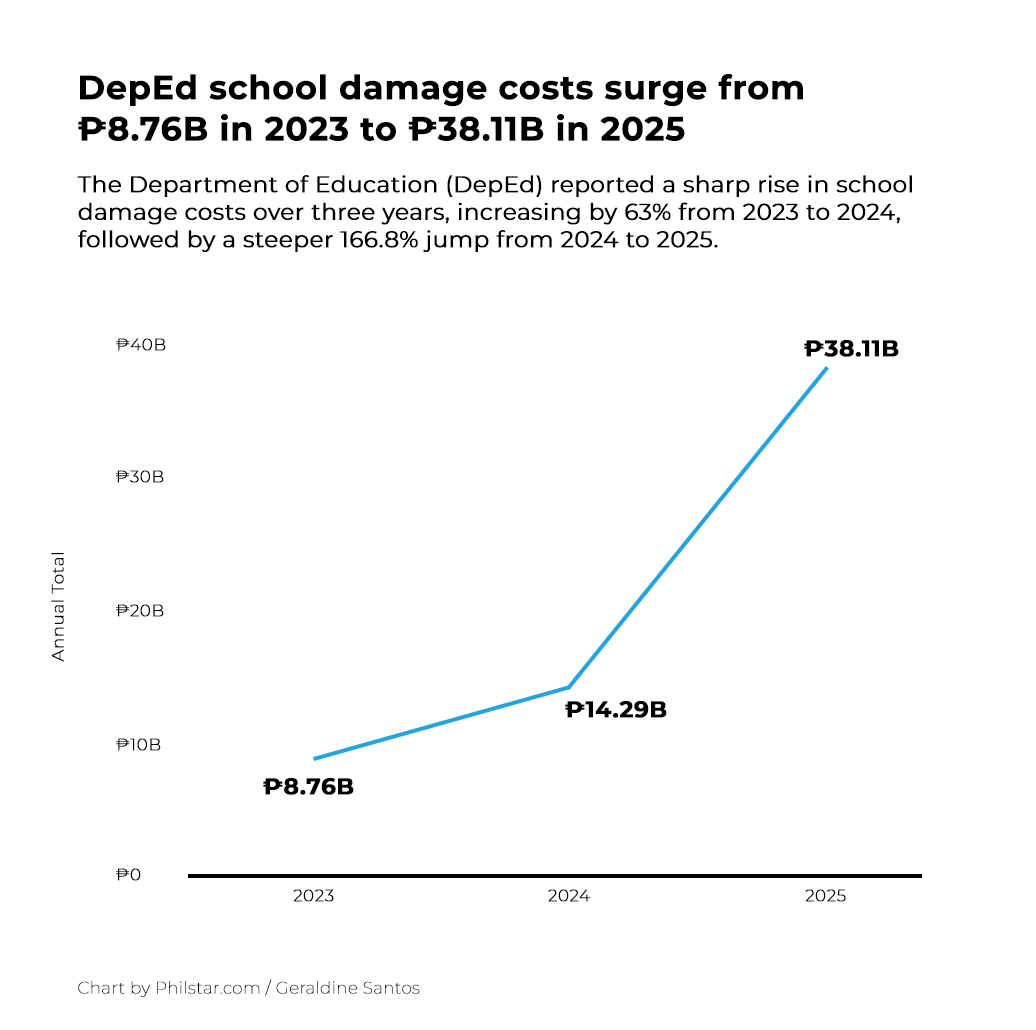
Chart by Philstar.com / Geraldine Santos
Education monitoring group Multiply Ed, which tracks 90 schools nationwide, said the same pattern holds far beyond Pampanga: where local or national government is slow to act, principals are forced to pull all the stops to find a solution.
"Parang tinatrato niya ito ng kanyang sariling bahay [It's as if they treat the school like their own home]," said Mark Alcazar, Multiply Ed's project officer.
Masantol and San Vicente–San Francisco High School, eight kilometers away in Macabebe, are two of 108 public schools that DepEd classifies as flood-prone in Pampanga, which has a total of over 500 schools.
Philstar.com visited both schools in March, during the dry season. Classrooms were back in use, but watermarks and unfinished repairs from the previous rainy season were still in plain view.

Some of the low-ceiling rooms at Masantol, including the one in picture, has been ordered destroyed as they are no longer fit for students and teachers to hold classes, according to Willet Sunga Perez, who was on her last term as school head at the time of interview, March 11, 2026.
Philstar.com / Efigenio Toledo IV
Perennial problem
At Masantol, former school head Perez explained that the school elevates classroom floors after consultations with DepEd's local physical facilities coordinator and disaster resilience focal person. She said the school coordinates closely with the local government in addressing the recurring floods.
Multiply Ed, an education monitoring group that deploys more than 300 volunteer monitors across 19 divisions, notes that every school files an annual School Improvement Plan listing what it needs, including classrooms and repairs. This is then used when the Central Office divides and downloads funds.
But in practice, the process is so slow that principals stop waiting for official requests to be approved and start fundraising and lobbying on their own.
“Principals are not required to do these things. But it happens because they need an immediate solution,” Alcazar said.
Former Education Secretary Edilberto de Jesus said the national classroom shortage has hovered around 165,000 since roughly 2009 — “over that period we have not made a dent,” he said — and is in truth larger once aging classrooms due for decommissioning and disaster losses are counted in.
De Jesus told Philstar.com the problem has always gone beyond DepEd even while he was the head of the department. School construction — before this year — has mostly been carried out by the Department of Public Works and Highways (DPWH).
"Construction projects, as we have pursued them, run into several structural problems," he said — a process he described as "intrinsically, inherently difficult," dependent on the DPWH and the coordination of several agencies, and slowed even by the right-of-way disputes that afflict many of DPWH’s projects.
The former secretary pointed to a second weakness: a lack of continuity at the top. For most of DepEd's history, he said, education secretaries have lasted only an average of three years each — rarely a full administration — too short to see big and bold infrastructure plans through. De Jesus himself served from 2002 to 2004 under former President Gloria Macapagal Arroyo.
The principals, meanwhile, stay for years and shoulder the problems that a centralized department is slow to fix.
Two recent secretaries have been the exception. Armin Luistro (2010–2016) and Leonor Briones (2016–2022) each completed a rare, full six-year term.
The carousel of resigning secretaries returned with Vice President Sara Duterte, who was appointed to the post in 2022 and resigned in 2024 amid her political break with the Marcos administration. Angara, the incumbent, was appointed in her place that July.
"A decentralized approach to this problem is going to take forever. You need construction at scale,” De Jesus said.
Multiply Ed, which has pushed for devolving more of DepEd's budget, does not dispute the need to build at scale, but Alcazar said their monitoring in recent years points to certain gains from decentralization.
The group has found that far-flung schools can wait years for requests routed through the national office, while local sources of funding — for instance, the Special Education Fund, now usable for classroom construction and repairs, and the LGU-led Classroom Acceleration Program — let communities act faster and build to a site's actual conditions instead of a single national template.
Disruptions from classes are already measured in lost learning. The Second Congressional Commission on Education (EDCOM II) estimates that 11 million public-school students lost some 53 teaching days to disasters in the 2023–2024 school year alone, or nearly three months. This is equal to roughly a quarter of an academic year.
The stilt-type model
DepEd's headline answer for schools like these is a new design: an elevated, stilt-type classroom, a building raised almost 2.5 meters off the ground on concrete columns, with an open multipurpose area underneath where floodwater can pass.
Each stilt classroom costs about P3.7 million (roughly $60,000), around P1 million more than a standard DepEd room, according to DepEd’s Pampanga division office.

One of the buildings at Masantol is DepEd's new stilt-type design facility which has the first floor as an open space, March 11, 2026.
Philstar.com / Efigenio Toledo IV
Angara inaugurated one at Masantol in August 2025 and held it up as a model for flood-prone areas nationwide.
In written answers to Philstar.com, Angara said the design lets classrooms stay "operational even during flooding," while the open ground floor doubles as community space.
But Angara has not said when — or whether — schools nationwide can expect the same.
The upgraded calamity-resilient designs, Angara said, are "still undergoing careful evaluation because of the significant additional costs involved." He framed the spending as worthwhile over time. "Resilience is a long-term investment," he said, one the government would otherwise lose to repeated repairs.
‘Every year we are running after the unpredictable’
Eight kilometers from Masantol, San Vicente-San Francisco High School has no stilt building, and its principal, Elmer Meneses, said he would take one in a heartbeat. He considers the elevated design the soundest fix he has seen for flooded campuses.
Meneses said he has spent the last five years improvising fixes for the school’s flooding problem through its maintenance budget.
After a failed attempt to wall the water out — a peripheral earth dike that eroded within a year, and diesel and electric pumps that only ran up the power bill — he had the entire campus landfilled in 2025, using operating funds, donations and fundraising from parents. Then Uwan came that November and flooded it anyway, rising 20 centimeters above the floor of the school's newest building, itself already raised three steps above the previous high-water mark.
“All our efforts have been surpassed by this recent flood,” Meneses said. “Every year we are running after the unpredictable.”
The flooding here is not only a typhoon problem, Meneses said, pointing to decades of land subsidence since the 1991 Mount Pinatubo eruption, un-desilted rivers and steadily raised roads in the surrounding barangays.
This has turned the campus into what Meneses calls a catch basin for floodwater.
“If you’ll try to find the ugliest campus, we will surely win,” Meneses said.

Elmer Meneses, school head of San Vicente San Francisco High School in Macabebe, Pampanga, shows the highest flood level reached during the onslaught of Super Typhoon Uwan (Fung-wong), March 11, 2026.
Philstar.com / Efigenio Toledo IV
As a result, Meneses said he has developed the skill and willingness to constantly ask.
He said he once requested 40 new classrooms and was turned down; the request was trimmed to 24, and what finally arrived was four, all of which were funded by the province's special education fund, and raised about 0.8 meters above the last flood line.
Even San Vicente's 15 temporary learning spaces came by chance after Meneses filled in for a relative at a meeting with DepEd disaster risk personnel. During this, Meneses said he heard that DepEd Region 3 had funds parked for temporary classrooms and asked for them on the spot. Built to last six months, they now run the whole-day classes the school could otherwise not hold.

Meneses on March 11, 2026 shows some of the Temporary Learning Spaces at San Vicente San Francisco High School. These are makeshift classrooms built in the aftermath of classrooms destroyed after a disaster.
Philstar.com / Efigenio Toledo IV
A model that doesn’t scale fast enough
Beyond flood-resilient infrastructure, the government — DepEd and other agencies — struggles to build classrooms at all.
In Pampanga, seven stilt buildings have been completed across four municipalities; the province has 108 flood-prone schools.
Nationwide, the pipeline is slower still: of the 24,964 classrooms funded in the 2026 budget, DepEd has said not all will be built within the year, since projects typically take two to three years and budget releases often arrive late.
The agency that long handled most school construction, the DPWH, completed just 22 classrooms in all of 2025.
In response, DepEd is pushing construction outward. For the first time since a 2018 rule gave the DPWH a near-monopoly, the 2026 budget lets local governments and even private and civil-society groups with proven records build classrooms. Angara has conceded the shift will bring "growing pains," but predicted it would be far more efficient than the old system.
Whether any of it reaches the worst-hit flood-prone schools — and on what timeline — is the question. Philstar.com sought comment from the office of Undersecretary Wilfredo Cabral, whose office oversees the department's Education Facilities Division, on how and when the stilt design will be scaled. This story will be updated with the department's response.
For De Jesus, he believes the current DepEd leadership is on the right track, but there must be an independent body that checks whether any of the proposed solutions are working.
"It can't be that DepEd is analyzing its own problems, proposing its own solutions," he said.
But as any teacher can attest, the scarcest resource schools have is time. Finished buildings tend to get overtaken by rising floodwaters almost as fast as they go up. The stilt design DepEd now showcases began with Rep. Anna York Bondoc (Pampanga, 4th District) funding the first one at Masantol, which opened in 2023. Within a year, floodwater reached it anyway, and the school had to build a second, higher one.
Perez is grateful to have one of the first few stilt-type buildings in Pampanga. But without elevated walkways, her students still wade to class through floodwater, many in flip-flops, to reach the rooms meant to keep them dry.
"Even if the buildings are flood-proof," she said, "the school grounds are not."