
 1 hour ago
5

Upgrade to High-Speed Internet for only ₱1499/month!
Enjoy up to 100 Mbps fiber broadband, perfect for browsing, streaming, and gaming.
Visit Suniway.ph to learn
Researchers aboard the Tara schooner are taking coral samples in Palawan and Mindoro to understand why the region's corals are so resilient
MANILA, Philippines – The Tara schooner makes its stop in the Philippines as part of its 18-month expedition in the Coral Triangle, attempting to understand why and how corals in the region are resisting climate change.
The storied schooner, built for polar drift in 1989 with its round aluminum hull, will be making stops in Araceli, Palawan, and Puerto Galera, Mindoro. It arrived in the Philippines on November 20 and docked at the Manila Yacht Club.
“It appears that coral reefs in the region seem to have a resistance and resilience potential that’s higher than everywhere else in the world, but we can’t explain really why,” Martin Alessandrini, advocacy officer of Tara Ocean Foundation, told reporters aboard the schooner on Thursday, November 26.
“It’s really a ray of hope for coral conservation, but we need to better understand it in order to better protect these corals.”
The Coral Triangle covers the Philippines, Indonesia, Malaysia, Papua New Guinea, Timor-Leste, and Solomon Islands, and contains majority of the known coral species in the world. It is known as the Amazon of the Ocean.
After leaving France at the end of 2025, the schooner crossed the Atlantic to reach the Pacific via the Panama Canal. Its first public stopover was in Tokyo, Japan, in April 2026. Prior to the Philippines, researchers in the schooner had stopped and collected samples from the waters of Papua New Guinea and Palau.
The team in the schooner mainly works on sampling. After collection, they send the samples to different laboratories for analysis. It takes two to three years after the expedition “to produce all the data and the very first results,” said Alessandrini.
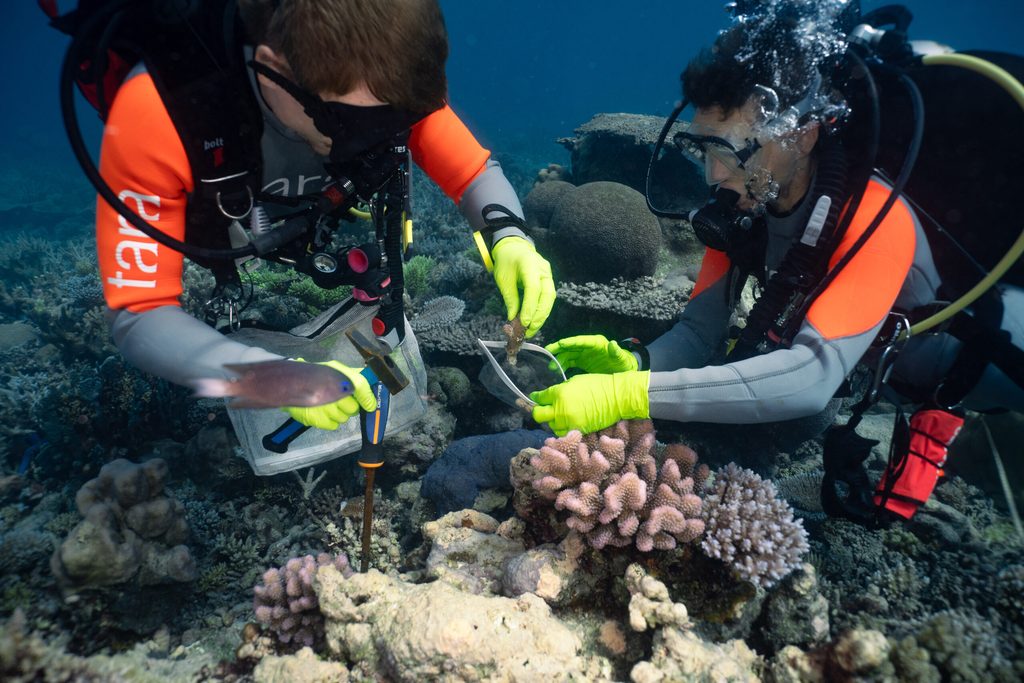 SAMPLING. Divers from the Tara schooner take coral samples in Palau.
Climate change has triggered coral bleaching events, threatening marine habitats around the world. Four global coral bleaching events have been recorded since 1998, according to a recent report from the Global Coral Reef Monitoring Network, with each event “associated with a 6.5–9.9% relative loss of global hard coral cover.”
Tara Ocean Foundation, based in Paris, France, supports the expedition and has partnered with the UP Marine Science Institute and non-profit organization Blue Alliance. The expedition vessel was designed by French naval architects Olivier Petit, Luc Bouvet, and engineer Michel Franco.
Inside the schooner
The vessel is manned by six sailors and eight scientists.
Below the cockpit is a common area where the staff holds meetings. In the kitchen are at least two packs of dry yeast and a KitchenAid stand mixer.
“Yes, we make bread everyday,” Alessandrini said as he toured reporters in the vessel. “It’s a French boat, so we need bread and we need good food.”
Further along are the sleeping quarters and bathrooms. There is a bookcase at the end of the hallway, lined with works of great authors.
The storage area beyond the sleeping quarters houses the watermaker (“to produce drinking water from seawater”), generators, and food stocks in huge containers.
All diving equipment is stored at the back of the boat, where coral samples are also kept and conserved.
“We take sediments around the corals,” Alessandrini explained. “We take fragments of corals also. And we take cores of corals, which help us understand the previous climate in the region.”
Filipino on board
Three Filipino researchers are slated to join the expedition at intervals during its Philippine leg.
Vince Nikko Ordinario, 27, is the first to join the team heading for Palawan. Ordinario, a research assistant at the UP Marine Science Institute, said he will be in the vessel for 40 days.
 SIGNAGE. The entrance to the cockpit is decorated with art and signages. Photo by Iya Gozum/Rappler
“I joined to help this expedition, get data, analyze,” Ordinario told Rappler in the schooner. “Then I can take it home to the laboratory. We can use the data in the laboratory.”
Two other Filipino researchers are joining in the latter half of the Philippine leg. After their stops in Palawan and Mindoro, the team would have been done with five out of the total nine sampling sites they intend to visit in the expedition.
Following the public stopover in Manila, the schooner is scheduled to stop by Kuala Terengganu, Malaysia, in July 2027 and then in Singapore in August 2027. – Rappler.com