 5 months ago
77
5 months ago
77

Upgrade to High-Speed Internet for only ₱1499/month!
Enjoy up to 100 Mbps fiber broadband, perfect for browsing, streaming, and gaming.
Visit Suniway.ph to learn
This week, over 2,000 delegates from 192 states around the world, along with representatives from civil society, the private sector, and the media, are in Doha, Qatar for what a veteran colleague aptly described as the “Coachella of anti-corruption advocates.”
Every two years, the United Nations Convention against Corruption (UNCAC) convenes the Conference of the States Parties (COSP), a gathering where member states discuss, negotiate, and pass resolutions that governments can use as a guide in implementing anti-graft policies back home.
Mounting a weeklong, high-level gathering to approve documents that do not compel governments to immediately enact policies might sound underwhelming on paper (and that may actually be the case). Still, any treaty language or resolution agreed upon here in Doha gives anti-corruption advocates ammunition to pressure their respective governments to step up and do better.
The COSP also provides neutral, UN-approved language that bilateral and multilateral donors use to justify their funding to a certain country. So yes, it’s also about money.

So far, I have seen more than 10 delegates from the Philippine delegation, led by Ombudsman Boying Remulla. Other top officials include anti-graft court Sandiganbayan Presiding Chief Geraldine Econg, new Chief Presidential Legal Counsel Anna Liza Logan, Procurement Service-Department of Budget and Management (PS-DBM) chief Genmaries Entredicho-Caong.
The Philippines is no longer the international pariah that it used to be when Rodrigo Duterte was the president, as the country under Ferdinand Marcos Jr.’s rule has become more open to dialogue with international bodies. So it’s no surprise that Philippine officials were met with attention rather than skepticism.
PS-DBM chief Entredicho-Caong touted ongoing procurement reforms in the Philippines, even though back home, journalists still struggle navigating the PhilGeps portal to aid in their investigations into the public works corruption scandal, which has taken the country by storm this year.

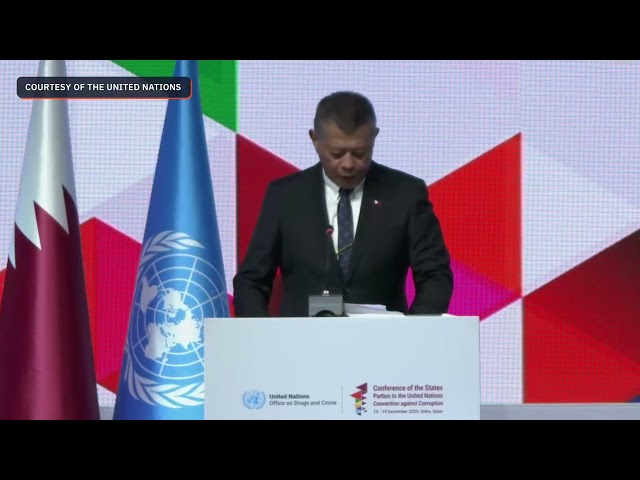
Remulla didn’t shy away from the controversy in the panels he was part of, calling the scale of flood control corruption — which involves executive agencies and the legislative — “unimaginable.” He also mentioned what his office has been doing, including the filing of cases against the officials involved.
Of course, a nuance lost on many foreign delegates is that the corruption scandal has been linked to Marcos himself and his associates. Remulla was appointed by the President but is constitutionally mandated to serve as an independent watchdog against government corruption. It makes one wonder how Malacañang officials like Logan frame the scandal in conversations with their foreign peers.
Cross-country collaborations
Remulla is honest about his intentions here: he wants to use the COSP as an opportunity to tighten the net on fugitives from justice, like Zaldy Co, the resigned congressman accused of being behind the national budget mess. Co is hiding abroad and refusing to come home to face the charges against him.
Remulla is referring not only to alleged masterminds of public works corruption who have fled — or may flee — the country, but also to bad actors involved in other crimes, such as illegal gambling. Before flood control irregularities dominated the national conversation, Filipinos were focused on scam hubs run by Philippine offshore gaming operators.
“The Office of the Ombudsman views robust regional and cross-regional cooperation not just as an option but a strategic necessity for the success in this modern age of fighting corruption,” Remulla said in one panel.
“We can start creating a network of countries that do not allow the people to run away and hide in one corner, and just live a happy life of anonymity in a foreign country,” he added in a separate panel.
Corruption being borderless is a recurring talking point in these panels, including in one that I was a part of. I am here upon the invitation United Nations Office and Drugs and Crime to represent Journalists Against Corruption (JAC), a network of Southeast Asian media practitioners.
My co-panelist Torplus “Nick” Yomnak made an interesting point: when corruption is treated solely as a domestic issue, civil society coalitions face structural barriers that are difficult to overcome.
While cross-border collaborations have increased in recent years, he pointed out that much of these collaborations remain ad hoc.
“It takes the form of meetings, workshops, and conferences — important and valuable, but often short-term. There is limited systematic facilitation, limited continuity, and limited long-term support. Once the event ends, the momentum often fades,” he said.
Nick added that a more structural response has begun to emerge. With support from UNODC and the Swedish government, they have established the Southeast Asian Anti-Corruption Network for Civil Society Organisations.
The same holds true for my organization JAC, which — as I pointed out in my panel — provided funding that enabled us to pursue our investigative stories on Zaldy Co. This Southeast Asian network has also provided a venue for data-sharing among like-minded journalists investigating corruption in their own countries.
Meanwhile, my fellow Filipino in the panel, Dexter Yang from the YouthLED board in Southeast Asia, stressed that corruption impacts young people most acutely, and underscored the need to include them in decision-making. (Dexter also attended the COSP in Atlanta, after which he wrote for Rappler about the lack of youth representation in the high-level summit).
Need for proactive delegation
Negotiations on numerous resolutions forwarded by other countries are still ongoing, though none is being sponsored or co-sponsored by the Philippines. Many of these resolutions are expected to be tabled before the summit closes on December 19.
Civil society delegates here have been ramping up efforts to convince state delegates from their own countries to attend the informal negotiations and support the resolutions.
So far, the Philippines has only attended negotiations on two resolutions, namely:
- the future of the UNCAC review mechanism, a key tool because what gets reviewed is what governments are ultimately pushed to fix;
- and one resolution that seeks to recognize corruption as a major cause of environmental crimes, urging signatories to develop strong domestic frameworks on transparency, open government participation, and access to information
It is important for the Philippine government to be more proactive in these negotiations. Sources here say there has been strong pushback from the United States on the political finance resolution, which encourages states to adopt stronger rules on campaign donations, beneficial ownership, and foreign interference.
Remulla has said the Philippines will support that resolution, but the delegation needs to walk the talk — attend the discussions and offer vocal support to sway holdouts — because there is strength in numbers. – Rappler.com