 5 months ago
44
5 months ago
44

Upgrade to High-Speed Internet for only ₱1499/month!
Enjoy up to 100 Mbps fiber broadband, perfect for browsing, streaming, and gaming.
Visit Suniway.ph to learn
Already have Rappler+?
to listen to groundbreaking journalism.
This is AI generated summarization, which may have errors. For context, always refer to the full article.

DIVORCE. To celebrate the country's 126th Independence Day, members and supporters of the Divorce Pilipinas Coalition-Cebu Chapter, call for the enactment of the absolute divorce bill as they gather in Cordova, Cebu, on June 12, 2024.
Jacqueline Hernandez/Rappler
The Family Code recognizes a Filipino's divorce with a foreign spouse obtained in another country
MANILA, Philippines – The local rules governing the recognition of foreign divorce in the Philippines are discriminatory to Filipinos, former Far Eastern University (FEU) law school dean Mel Sta. Maria told the Supreme Court (SC) on Tuesday, April 28.
“Our policy today on disallowing recognition…I’m sorry to say, borders on racism, is xenocentric, and it mirrors a colonial mentality where the natives have less rights…. And if they want to have more rights they have to associate themselves with a foreigner,” Sta. Maria said during the SC’s continuation of oral arguments on the recognition foreign divorce in the country.
“It is so deleterious to our culture and our tradition, your honor. This is discriminatory,” he added.
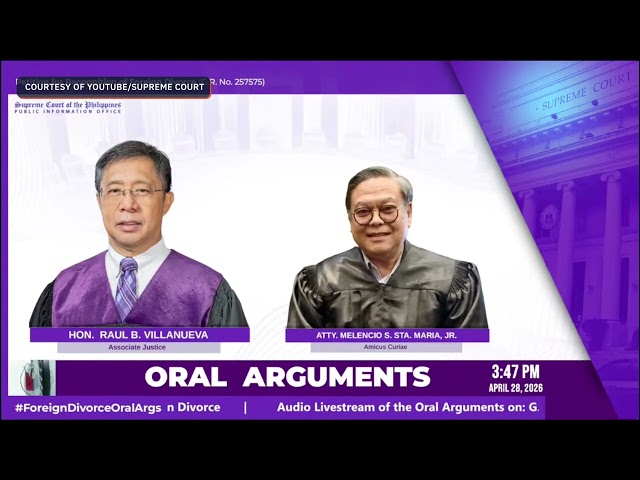
The SC’s oral arguments are for the case (GR No. 257575) that involves a Filipino national with dual citizenship who obtained divorce abroad. The petitioner acquired foreign citizenship through naturalization, and later reacquired Philippine citizenship.
When the petitioner sought the divorce to be recognized locally, a Nueva Ecija court junked the petition. This prompted the petitioner to ask for the High Court’s intervention.
Apart from the Vatican City, the Roman Catholic church’s seat of power, the Philippines is the only country with no divorce laws. The only way to dissolve a marriage in the devout Catholic Asian nation is through declaration of nullity of marriage and annulment.
However, a Filipino’s divorce from a foreign spouse, obtained in another country, may be recognized in the Philippines.
Under article 26, paragraph 2 of the Family Code, Filipinos previously married to foreigners can ask Philippine courts to recognize their foreign divorce.

For Sta. Maria, who is sitting as an amicus curiae (friend of the court) or expert for the oral arguments, it’s unfair for Filipinos to be able to obtain a divorce only when a foreigner is involved.
“‘Pagka parehong Filipino, automatic rejection ang petition for recognition. Kung Filipino at foreigner, [puwedeng i-recognize] (If the petitioners are both Filipinos, the petition for recognition is automatically rejected. But if it involves a Filipino and a foreigner, the divorce could be recognized,” Sta. Maria told Rappler in a message.
“Why is it, your honor, that the only magic [for recognizing a foreign divorce] is the presence of a foreigner? That is unpatriotic, your honor,” the law expert told the SC during Tuesday’s arguments.
During last year’s arguments, family law expert and amicus curiae Katrina Legarda revealed that some overseas Filipino workers go to Guam for divorce because the territory requires only a seven-day residency. After securing residency, the OFWs then file for divorce which can be later recognized in the country. (READ: OFWs find divorce shortcut in Guam – lawyer). – Rappler.com
How does this make you feel?
Loading