 6 months ago
88
6 months ago
88

Upgrade to High-Speed Internet for only ₱1499/month!
Enjoy up to 100 Mbps fiber broadband, perfect for browsing, streaming, and gaming.
Visit Suniway.ph to learn
Already have Rappler+?
to listen to groundbreaking journalism.
This is AI generated summarization, which may have errors. For context, always refer to the full article.

FUEL PRICES. Another round of fuel price hikes is seen on the price board of a gas station in Paco, Manila on April 7, 2026. Oil companies raise gasoline prices by as much as ₱5.90 per liter and diesel by up to ₱19.80 per liter.
Rappler
'Any attempt to mislead the public about energy security, supply, or pricing to sow confusion will be treated as a serious offense,' warns Communications chief Dave Gomez
MANILA, Philippines – Malacañang on Tuesday, April 7, filed with the Department of Justice (DOJ) its “initial investigation” into what the Presidential Communications Office (PCO) described as “posting fake news in a malicious desire to sow public panic and confusion and undermine public welfare and safety” in relation to the national energy emergency in the country.
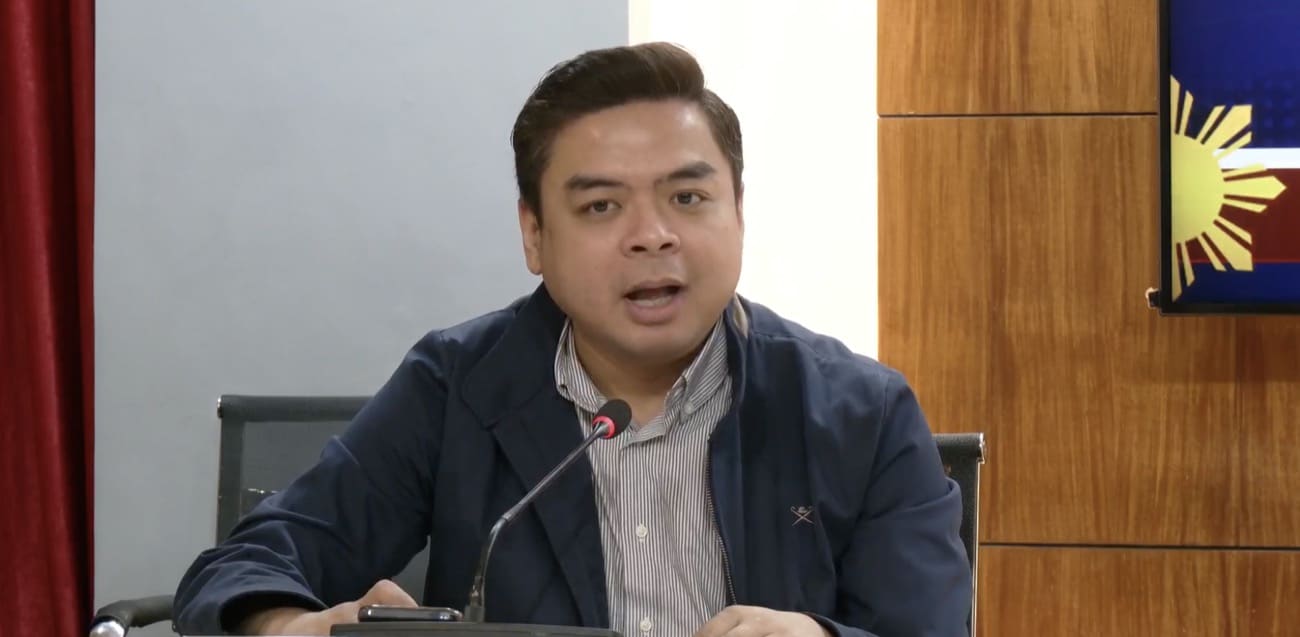
Acting Communications Secretary Dave Gomez himself appeared at the DOJ to turn over initial information related to a Facebook page, which he said in a statement was flagged by his department’s “Anti-Fake-News Desk.” The Facebook page had supposedly made posts purporting an “energy lockdown,” a “fuel shortage,” and an “emergency lockdown.”
“Last Sunday, we issued a stern warning against anyone who would deliberately fabricate and spread ‘fake news’ over the Internet to advance their personal and political interest in this time of energy emergency that they will be held to account to the full extent of the law,” he said.
Gomez and the PCO want the DOJ to further probe and determine the persons behind the Facebook page “Malasakit News Pilipinas.” A Facebook page bearing that name has some 13,000 followers as of posting. Most of its most recent content are videos that resemble traditional television news reports.
“We are asking the Department of Justice to investigate at least three ‘fake news’ posts, determine the persons that fabricated them, and bring them to court on behalf of the Filipino people to answer for the harm they have caused the public…. All these posts are blatant lies and fabrications that fall under the definition of ‘false news,’ the publication of which is deemed a crime punishable by up to six months imprisonment under Article 154 of the Revised Penal Code,” Gomez said.
Under Article 154, persons found to have “maliciously [published] as news any false news which may endanger the public order or cause damage to the interest or credit of the State” may face imprisonment of a month to 6 months, and a fine between P40,000 and P100,000.
“We remind users of social media platforms that the government will exercise zero tolerance for those who maliciously and deliberately spread utter falsehoods and fabricated content. Any attempt to mislead the public about energy security, supply, or pricing to sow confusion will be treated as a serious offense. We will not let you get away with a crime. We will go after you and hold you to account,” Gomez said.
“Our ultimate obligation is to safeguard the stability of energy supply, protect consumers, and uphold the public’s right to true and accurate information,” he added.
President Ferdinand Marcos Jr., in late March, placed the Philippines under a yearlong state of national energy emergency as oil prices continued to rise as a result of the United States and Israel’s war on Iran. Strikes between the two sides have destroyed key energy facilities in the Gulf, including in neighboring nations with ties to the United States.
Most critically for Middle East-dependent Asia, the war has resulted in Iran keeping control of passage through the Strait of Hormuz, where 20% of the world’s oil — most of it for the region — once passed through daily. The Philippines sources almost all of its oil from the Middle East.
The administration has thus far ordered agencies under the executive branch to reduce their energy consumption as prices continue to rise. Marcos had also created an interagency committee meant to mitigate the impacts of the global oil crisis.
The Association of Southeast Asian Nations, which the Philippines chairs, is expected to focus solely on addressing the effects of the crisis when its leaders meet for the first time in 2026 in Cebu by early May. – Rappler.com
How does this make you feel?
Loading