 5 months ago
54
5 months ago
54

Upgrade to High-Speed Internet for only ₱1499/month!
Enjoy up to 100 Mbps fiber broadband, perfect for browsing, streaming, and gaming.
Visit Suniway.ph to learn
MANILA, Philippines – The International Criminal Court (ICC), through the Trust Fund for Victims, wants to start an assistance program for the victims of the drug war and the Davao Death Squad (DDS) in the Philippines “as soon as possible” but this would all depend on funding availability, TFV’s head told Rappler.
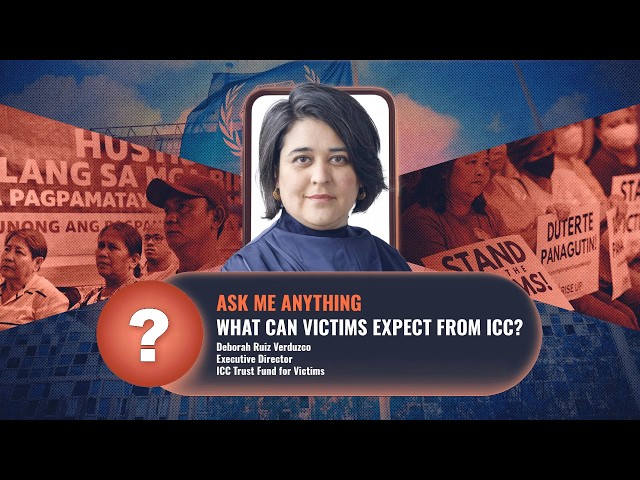
“It’s about time. The situation in the Philippines was opened many years ago, and the trust fund wishes to be available as soon as possible,” Deborah Ruiz Verduzco, the TFV’s executive director, told Rappler on Wednesday, April 15, in an Ask Me Anything interview.
But asked whether she can confidently say that the TFV is in good financial health to fund future activities, Verduzco said: “No, I cannot confidently say this…. We are at the very early stages. There are no resources guaranteed at the moment to confidently say that there is a program.”
The TFV is another unit within the ICC system that gets its budget the same way the ICC does, which is through the voluntary contribution of the court’s member countries. But it also relies on donors and pledges to administer a crucial part of its brand of justice, which are reparations and assistance.
The TFV administers reparations only after a suspect has been convicted, and the ICC has delivered a reparations order which sets out how much money is due to the victims it identified. The reparations can be sourced from seized assets of the convicted suspect, if any.
But that’s looking too far ahead in terms of the Philippines’ case which is only at the confirmation stage, nearing a decision expected by the end of this month if trial will push through.
Assistance mandate
But the TFV has a second mandate, which is assistance. Assistance can be triggered even before conviction, and Verduzco said consultation is now in “its very initial stage” to start that process for the Philippines.
It’s the board of directors that will eventually decide. Verduzco said this decision relies heavily on the availability of funding because they do not want to “be risking starting something that we cannot later continue.”
Verduzco said she is hopeful that the board will give the green light. “There are limitations, and we are not a rapid response instrument. So we know we are ourselves under pressure. We want to start this program and these measures as soon as possible. So in terms of speeding up our work, what we are hoping is that we will continue it within the timeline,” she said.
The type of assistance will depend on what victims want and need. It can be in the form of a medical assistance, educational assistance, or setting up a memorialization system to preserve the truth.
Verduzco said they are aware that economic hardship is the dominant challenge faced by the victims of extrajudicial killings in the Philippines.
“We have heard that there is enormous impact as those affected by illegal actions such as extrajudicial killings or detentions were the main breadwinners of families, and therefore family members are now indisposed and face enormous economic hardship,” she said.
Verduzco said relocations to another country to secure victims, and possibly victim-witnesses, are not under the TFV’s mandate, but the Registry’s.
How will it work?
Beneficiaries of the assistance do not depend on whether the victim has been participating in the criminal proceedings at the ICC. “There is no relation between that participation in the judicial proceeding or participation in the assistance program,” said Verduzco.
In that sense, this will have broader coverage, and will ease some anxieties among victims, especially those who have not yet been admitted to the criminal proceedings. Currently, there are 539 participating victims in the criminal proceedings, and the ICC will reopen application should it move to trial.
However, given that many victims were killed by unidentified vigilantes, some consider themselves “legally weak cases.” Verduzco said they would still have a chance to be covered by the assistance program, as the minimum qualification is that you are a victim who suffered from the harm of the crimes alleged in the case.
“The minimum qualification is that the harm suffered needs to be linked to the situation that the ICC is investigating. If something happened to you that is not linked to what the ICC is in general investigating — not a specific case — but the situation as a whole is, then there is a prospect of being part of the assistance program,” said Verduzco.
‘We cannot address every single victim’
But it won’t be a straightforward process, and “we cannot address every single victim,” she said.
“We ask the victims what is it that they want, how these crimes have impacted them, and then we need to make very difficult decisions that mean that we cannot address every harm, we cannot address every single victim. So we need to prioritize,” said Verduzco.
“Maybe we will prioritize a location or we will prioritize a certain type of victim,” Verduzco said.
“We could prioritize victims of sexual and gender-based violence or we could prioritize victims that are children or we could be prioritizing a specific location. And we will be designing a program that seeks to address those harms. It is important that these programs bring also social cohesion because some victims will benefit and not others,” she added.
When the assistance program kicks in, the TFV will also determine the right organizations that will implement the programs. This will be decided through “committees that are set up with external entities also inside of the ICC who helps us do the selection in a fair manner.” There’s also the possibility of collaborating with the national government.
Verduzco said they will be applying a very careful, and conflict-sensitive methodology for this process.
“We, as trust fund, are bound to ensure that our measures do not carry additional harm to victims. And we are also required to ensure accessibility. We are also required to ensure gender sensitivity and gender inclusion. We are also required to look into the best interest of the child. And we are also required to look at conflict sensitivity,” said Verduzco.
Right now, the TFV is also in the middle of implementing a reparations order in the case of the Ugandan Dominic Ongwen. The ICC last year awarded 52.4 million euros to nearly 50,000 victims.
“We know we are pressed,” said Verduzco.
In the meantime, she advised the victims to start dialogues.
“It is very important that victims are well organized, that victims are united. The solutions start at home in the first place, start also with a dialogue with the government to try to advocate as well at the local and national level. Solidarity is what the Trust Fund for Victims is advocating, and solidarity and cooperation can exist also in the absence of the trust fund,” said Verduzco.
If there’s something more concrete, the victims will know, she said.
“There will be general criteria, there will be outreach campaigns, and they will know if there is that possibility,” said Verduzco. – Rappler.com