 1 hour ago
6
1 hour ago
6

Upgrade to High-Speed Internet for only ₱1499/month!
Enjoy up to 100 Mbps fiber broadband, perfect for browsing, streaming, and gaming.
Visit Suniway.ph to learn
BC Amparado’s third feature Mono No Aware, arguably a best-of-fest entry at this year’s CinePanalo Film Festival, covers new ground for the Angeles-born writer-director.
For one, it trades the trippy spirit of his debut feature Gulay Lang, Manong or the disorienting, subplot-heavy style of last year’s Salikmata for a more slow-burn, pensive ethos.
His latest follows Ichi (Juan Karlos Labajo), a Filipino kodokushi (lonely death) worker who tries to fulfill an absurd wish from the elderly widower George (Perry Dizon). Both adrift in Japan’s cold, isolating environment, the two souls find warmth in one another and rediscover how life can suddenly freeze and then thaw into something hopeful.
“It’s as if you’re there watching the characters watching the world,” Amparado said of the film, which points to contemporary Japanese films, the likes of Wim Wenders’ Perfect Days and Hirokazu Koreeda’s Shoplifters, as sources of inspiration.
“It’s more about the impermanence of life and decay. For me, there is life in death and life in decay.”
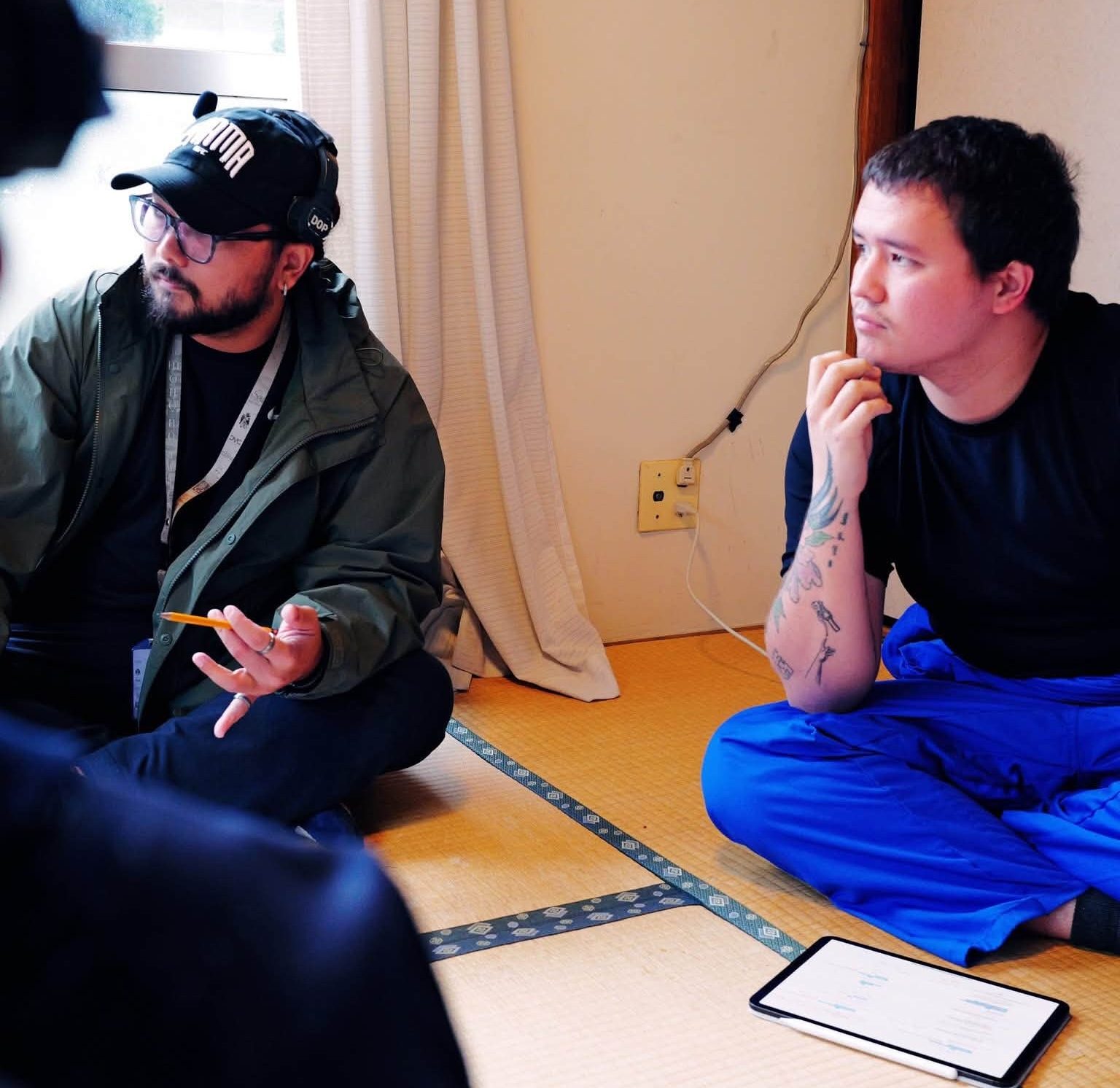 Director BC Amparado (left) and Juan Karlos Labajo on the set of ‘Mono No Aware.’
Filming in Japan for 11 days, Mono No Aware also finds Amparado working with international players for the first time, an experience that taught him to be more disciplined and intentional in his process.
“You should really be decisive,” he said. “You have to trust yourself that you’ve got a good take, and then move on.”
Most notably, the movie marks his full-fledged pivot to independent filmmaking, leaving behind his corporate job and the financial stability it used to offer. It was a risk, said the director. But that was a risk he was willing to take.
“Because the process became quite demanding,” Amparado said. “And then we had to fly out to Japan. So much pre-production work required my focus. And so balancing the schedule became challenging, especially when I had graveyard shifts.”
He added, “Yes, it was risky. But somehow it was also fulfilling. And I was happy with my decision.”
Amparado’s foray into moviemaking began during his time at Holy Angel University, in the classes of his mentor Jason Paul Laxamana.
“He’d always encourage us to enter filmmaking,” he said of Laxamana, who also wrote Salikmata. “He’d bring us to his shoots, and there I saw the joy of doing film and telling stories.”
But even prior to that, Amparado has always been drawn to the allure of the movies as a frequent viewer. Before writing and directing, he first entertained the idea of becoming an editor. He would kill time by toying with a free editing software they had at home.
“I enjoyed stitching stories together as well as the amateur videos we would shoot then,” he recalled. That is, until he found editing too technical a skill, eventually shifting to writing and directing.
“Editing is another beast,” Amparado admitted. “Maybe that’s why I also enjoyed the post-production process for my films because I get to collaborate with editors. Every time we finish shooting, I always get excited to proceed with the edit, especially if you know what you shot by heart.”
“And usually what’s written in the script doesn’t end up as the final output,” the director continued. “It’s nice to play around with. It becomes a mental exercise for us, especially how to figure out the rhythm of the film.”
His brother, Paolo Amparado, who shot Salikmata and acted in his 2013 debut short Cabatingan, was another influence. “We became a tandem because I’d focus on writing and direction, and then he’d work on the technical side, like camera work and editing,” BC said of Paolo, who’s now based in Canada.
Sometime in 2018, Amparado started working in regional television as a producer, and then as a writer-director for a local production house, before eventually going corporate. While producing online ads for the likes of YouTube and Facebook for his day job, he was writing and directing short films on the side.
As in his latest film, it was a slow burn for Amparado as a filmmaker, only making his debut feature in Cinemalaya two years ago.
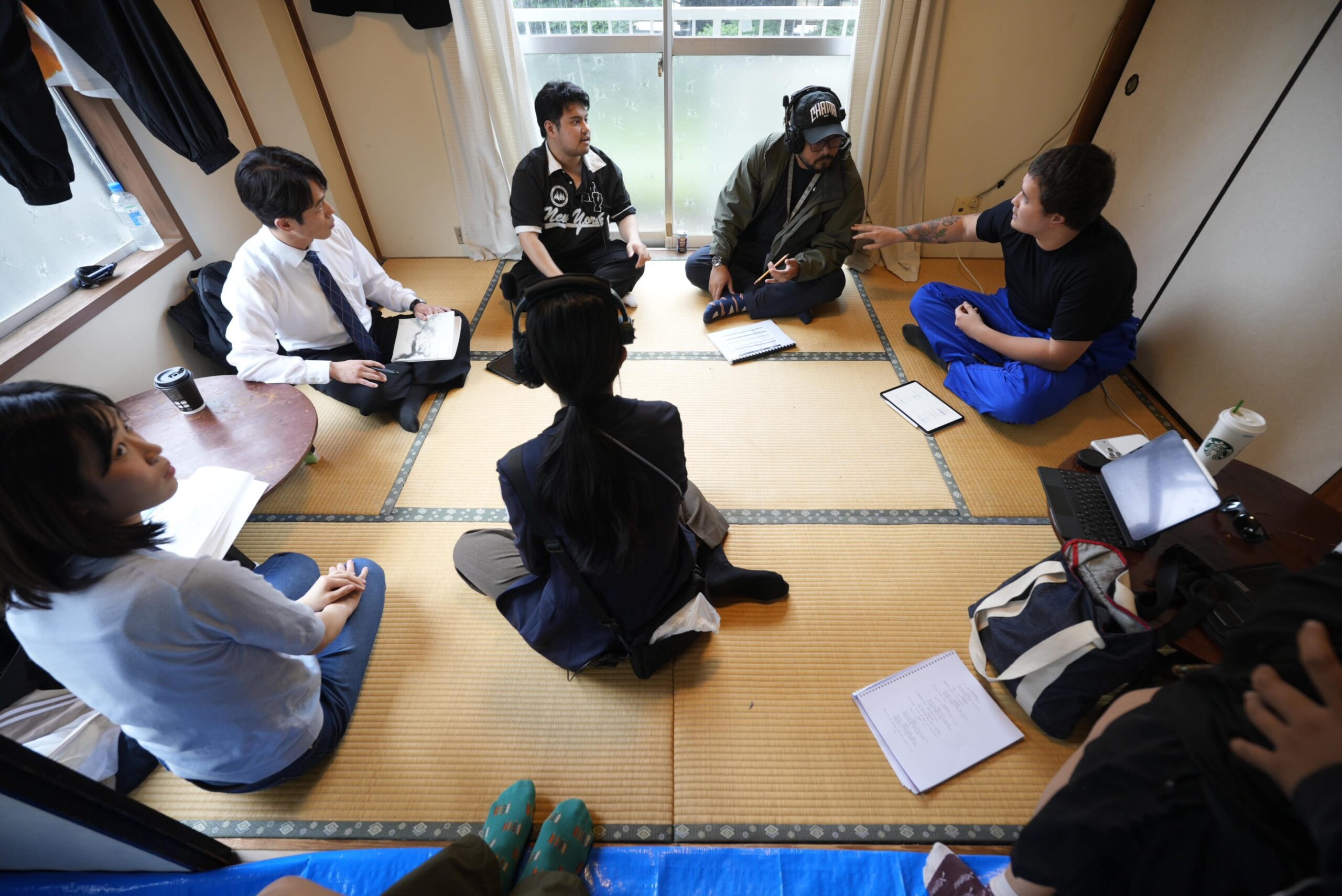 The cast and crew of ‘Mono No Aware’ filming in Japan.
 The long-gestating Mono No Aware, whose story riffs on Japan’s lonely death phenomenon known as kodokushi, was meant to be the filmmaker’s debut. But given the story’s setting, Amparado thought it would be impossible to have an international co-production for a first film.
The concept first came to him around 2020 and was later shaped under Ricky Lee’s online screenwriting workshop where a classmate showed interest in the material, offering to acquire and develop it for a different director.
That offer, however, did not pan out, and so Amparado had to shelve the project, before approaching Perry Dizon about it, while making Gulay Lang, Manong together. Still, much of that talk was wishful thinking. Then came CinePanalo.
The director said Dizon was perfect for the role given his long-haired, seemingly reclusive look at the time. Not to mention that the actor already had previous experience filming in Japan, after his attachment to Ryusuke Hamaguchi’s Oscar-winning drama Drive My Car.
Amparado likened Dizon to a cowboy. “He’s adept at adjusting,” he said. “He also arrived early in Japan to immerse in the process. Even during pre-prod, when he was still in Davao, we’d exchange ideas over video calls. He’s solid in terms of preparation.”
Juan Karlos Labajo, meanwhile, joined the film as lead actor and co-producer through producer Tin Velasco, whom he had previously worked with. Amparado said it was also a factor that Labajo could speak Bisaya like Dizon, another layer to them playing two Filipino characters far away from home, therefore forming an organic synergy on- and off-screen.
Such parallels inescapably inform Amparado’s durational effort, which sublimely articulates how grief and hardship can reorient one’s relationship with the world around them. Ichi and George’s sources of suffering — one about material precarity, the other about purgatorial immobility — seem wildly incongruous at first, but the director profoundly tests their edges until they collide, with a late pivot towards, but not a complete surrender to, pessimism. Here is a work of accomplished form and substantial depth. – Rappler.com
Some quotes in Filipino have been translated into English for brevity.