.png) 7 months ago
103
7 months ago
103

Upgrade to High-Speed Internet for only ₱1499/month!
Enjoy up to 100 Mbps fiber broadband, perfect for browsing, streaming, and gaming.
Visit Suniway.ph to learn
Keisha Ta-Asan - The Philippine Star
January 12, 2026 | 12:00am
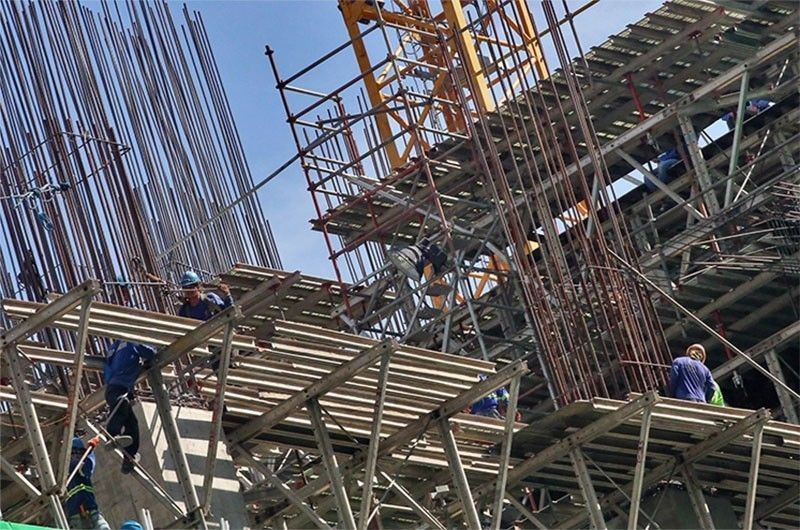
MANILA, Philippines — Private construction growth in the Philippines is being driven largely by residential projects and concentrated among big developers, while credit is increasingly flowing to consumption rather than productive investment, prompting economists to warn about the weakening quality and sustainability of growth.
Latest data from the Philippine Statistics Authority showed private construction expanding by 13.9 percent even as public construction collapsed by 26.2 percent.
At the same time, gross capital formation contracted by 2.8 percent, durable equipment investment rose only 0.6 percent and credit card receivables surged by 29.5 percent, highlighting what analysts describe as a growing imbalance in the economy’s growth drivers.
UnionBank chief economist Ruben Carlo Asuncion said the recent pickup in private construction reflects residential activity, particularly mid- to high-rise condominium projects where developers are completing pipeline units. Meanwhile, industrial and logistics projects remain a smaller share compared with residential.
“The momentum is still primarily in long-standing residential pipelines rather than new capacity-oriented builds,” Asuncion said.
He said the weak growth in durable equipment investment points to caution among firms that are not yet committing to large-scale capacity expansion.
“Developers may be finishing existing projects, but broader corporate investment appetite remains cautious,” he said, adding that “typically, if firms were scaling up operations, we would see stronger equipment investment accompanying construction activity.”
Asuncion said the rebound in private construction appears concentrated among large, well-capitalized developers with stronger pre-sales and better liquidity, while smaller developers remain significantly constrained by tighter credit conditions and elevated interest rates.
Banks, he said, have also become more selective, particularly for new or higher-risk projects, with many large developers now relying more on internal funding sources or equity rather than fresh credit to sustain ongoing projects.
While private construction can continue in the near term due to existing pipelines, Asuncion warned that “sustaining growth will be difficult if public construction continues to contract,” noting that “public infrastructure tends to crowd in private investment by improving connectivity and boosting demand.”
“A prolonged slump raises downside risks for the sector,” he said.
Pantheon Macroeconomics chief emerging Asia economist Miguel Chanco said it is difficult to get a detailed breakdown of private construction, but added that the weak performance of equipment investment suggests firms lack confidence in future demand.
“The still tepid-rise of such investment suggest that firms don’t have that much confidence on the strength of future demand,” Chanco said, noting that Philippine central bank surveys show companies are probably operating below capacity.
“With capacity utilization treading water below its historical average, there really is no urgent need to raise productive capacity in the current climate,” he said.
Chanco also said private construction activity is likely concentrated among large firms. “Access to credit remains difficult for most and only large firms have pools of cash readily available to draw from,” he said.
Over the longer term, he said private construction cannot thrive without public infrastructure. “Private developments, whether residential or commercial, depend on there being greater connectivity,” he said, although in the short run, weak public construction could reduce competition for resources and indirectly benefit private developers.
PIDS senior research fellow John Paolo Rivera echoed these views, saying private construction growth is being driven largely by residential and commercial developments, with some expansion in logistics and industrial facilities, but housing and mixed-use projects remain dominant.
“Weak growth in durable equipment investment suggests firms are building space without fully scaling up operations, reflecting cautious business sentiment,” Rivera said.
“These projects are mostly undertaken by large, well-capitalized developers, while banks remain selective in construction and project finance, pushing more developments to rely on equity, pre-sales or internal funds.”
While this could “sustain activity in the short term,” Rivera warned that “continued weakness in public infrastructure spending will eventually constrain private construction’s impact.”
Concerns are also mounting over the composition of credit growth. Central bank data show bank lending expanding by 10.5 percent in October, while credit card receivables surged by 29.5 percent, even as investment contracted.
Asuncion said this “clearly indicates that a larger share of incremental credit is flowing to consumption rather than production.”
“It is not an immediate crisis signal, but it is a yellow flag,” he said. “Rapid growth in unsecured consumer credit — especially at nearly 30 percent year-on-year — while investment contracts is a concerning divergence. It raises vulnerability, particularly if household incomes don’t keep pace.”
Asuncion said “there is a case for targeted macroprudential measures to ensure consumer credit expansion remains aligned with repayment capacity,” stressing that “the goal would not be to limit access but to prevent excessive leverage buildup in unsecured lending.”
Chanco said this trend has been in place for years. “This has been a trend we have been flagging up to the potential detriment of private consumption growth in the future,” he said. “We really doubt that this household debt binge can continue indefinitely without something of a painful payback.”
He added that consumer credit is “by its nature… less ‘secure’ (no collateral),” reinforcing concerns over financial vulnerability.
Rivera said the broader picture is becoming more troubling. “Overall, the Philippine economy risks borrowing to consume rather than borrowing to build, resulting in growth that is demand-supported but not productivity-driven,” he said.
Asuncion shared the same concern. “Growth is holding up, but the composition is becoming less healthy,” he said. “Investment is weak, public construction has contracted sharply, and consumption is increasingly credit-driven.”