 1 hour ago
1
1 hour ago
1

Upgrade to High-Speed Internet for only ₱1499/month!
Enjoy up to 100 Mbps fiber broadband, perfect for browsing, streaming, and gaming.
Visit Suniway.ph to learn
Already have Rappler+?
to listen to groundbreaking journalism.
This is AI generated summarization, which may have errors. For context, always refer to the full article.

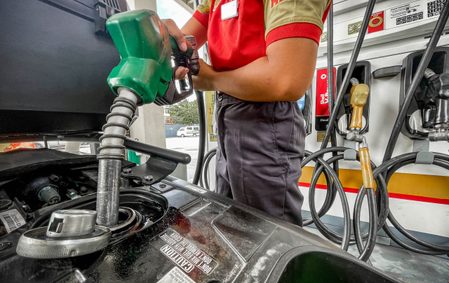
Motorists refuel at a gas station in Manila ahead of another round of oil price increases, with partial adjustments already in effect, on March 17, 2026.
Rappler
For the past three weeks, the price rollbacks for diesel add up to P58.77 per liter, bringing the pump price closer to its pre-war level
MANILA, Philippines – For the third straight week, pump prices for diesel and kerosene are going to be rolled back.
Energy Secretary Sharon Garin announced a minimum price reduction of P12.94 per liter for diesel, and P15.71 per liter for kerosene, for the week of April 28 to May 4.
Meanwhile, gasoline pump prices will increase by P0.53 per liter.
The P12.94 per liter rollback for diesel follows two bigger price reductions: P24.94 per liter for April 21 to 27, and P20.89 per liter for April 14 to 20, or a total price reduction of P58.77 for the past three weeks.
Diesel is the most important fuel in the Philippines since most public utility jeepneys and delivery trucks are run using this fuel.
Energy Secretary Sharon Garin said in a press conference on April 20 that the Philippines’ diesel supply was still good for 52 days.
For gasoline, the P0.53 per liter increase follows a P3.41 per liter cut from April 21 to 27, and P4.43 per liter reduction from April 14 to 20.
For kerosene, the P15.71 per liter price cut comes after P2 per liter reduction from April 21 to 27, and P8.50 per liter from April 14 to 20.
Garin said on April 21 the price rollbacks announced by government are the prescribed minimum price reductions. Oil companies can have price cuts higher than the minimum but not lower.
These price cuts are big relief to consumers who have had to face higher transport and food costs following the US-Israel war on Iran on February 28.
Before the war, the common price of diesel in the NCR was only P55 per liter; for the cheapest gasoline (RON 91), it was P54.70 per liter; for kerosene, P83.47 per liter.
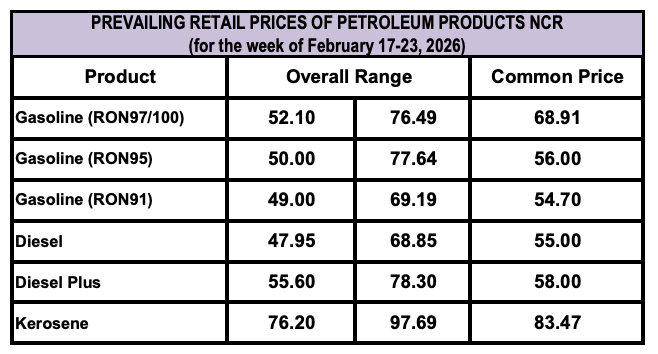 Pre-war prices and price range of petroleum products in the National Capital Region. Image from Department of Energy
Even though the oil industry in the Philippines is deregulated, the government has been prescribing price reductions based on the declaration of a state of national energy emergency.
In its April 21 oil monitor, the Department of Energy (DOE) said “crude prices softened as risk sentiment improved following a temporary ceasefire between Israel and Lebanon and renewed optimism over the potential reopening of the Strait of Hormuz ahead of planned US–Iran talks.”
“The Asian diesel market remains supported but less tight as easing geopolitical risks temper sentiment. Limited volumes of South Korean cargoes have begun to re‑emerge, though overall supply recovery remains constrained,” the DOE said.
However, it said the crude oil market is “expected to remain highly volatile, supported by restricted tanker traffic through the Strait of Hormuz amid uncertainty over the duration and enforcement of the US blockade.”
The Philippines imports nearly all its crude oil and refined petroleum products. Private oil companies such as Petron, Shell, Chevron, and the independent oil players secure their supplies and set prices based on global market and local competition.
“Prices reflect the costs of restocking fuel today at current market rates, not what was paid for the existing stock in the tank,” the DOE earlier said.
The Philippines has no strategic petroleum reserve, but Garin has expressed support to putting up one.
Petron’s general manager Luben Nepomuceno has recommended to Philippine policy makers that government put up a “strategic stockpile,” saying this is a “best practice in other countries to provide buffer stock and stabilize prices during periods of supply disruption.”
For a 90-day or three-month stockpile of 15 million barrels of crude from which Petron can process 5 million barrels per month and produce 25 million liters daily, Nepomuceno said this will require an investment of P54 billion, based on stockpiling at the pre-war level of $60 per barrel. – Rappler.com
How does this make you feel?
Loading