 1 hour ago
6

Upgrade to High-Speed Internet for only ₱1499/month!
Enjoy up to 100 Mbps fiber broadband, perfect for browsing, streaming, and gaming.
Visit Suniway.ph to learn
In May 2025, a regional office of the Philippines’ fisheries agency in Visayas announced an initiative that would invite fishers to government meetings held to expand fish farming in the region.
Officials would introduce the fishers to ongoing fish breeding, processing, and distribution projects as part of a push to transform the local economy “from fish hunting to fish farming.” They emphasized that this transformation would ease stress on the ecosystem.
“Instead of constantly taking from the sea, let’s try to cultivate fish and give the ocean a chance to recover,” said community development officer Joel Lutao.
But critics worldwide have questioned whether the practice of catching and reducing whole, fresh fish to grow more seafood can ever be considered sustainable. The most popular types of farmed seafood — milkfish, tilapia, salmon, shrimp, and trout — are fed the kinds of wild fish that aquaculture claims to be saving, thereby accelerating ocean depletion, not slowing it.
Two-thirds of global aquaculture grows species that are fed fishmeal and fish oil. Before it reaches market, a farmed salmon, for instance, eats at some farms more than six times its weight in wild-caught fish.
The concerns about aquaculture extend far beyond the fate of the oceans. The feed that powers most of this industry comes with a huge variety of other hidden costs, according to a wide-reaching investigation by The Outlaw Ocean Project, a news organization based in Washington, DC.
These costs include the loss of artisanal fishing jobs, chronic chemical exposure, avoidable worker deaths, violent protests typically spurred by the horrid smell from fishmeal factories, and escalating geopolitical tensions as countries compete for scarce sources of protein.
‘There’s no fish left here’
What economists often call “externalities,” these social and environmental impacts exact a price primarily paid by the poorer countries where the feed ingredient is harvested and processed, far from where the resulting luxury seafood is eaten.
In The Gambia and Mauritania, the investigation documented how the industry drives food insecurity, as fish that once sustained local communities are increasingly being diverted into fishmeal factories for export.
In remote islands in Russia’s far east and in China’s Xinjiang region, the reporting detailed the use of forced labor on ships, at farms, and in factories.
In other countries, including India and Peru, this industry was tied to at least 80 incidents of civil unrest, some of them violent, usually in the form of labor strikes and community protests sparked by the water pollution or stench from factories cooking thousands of tons of decomposing fish, according to Bait to Plate, an online tool that tracks the fishing and seafood industries.
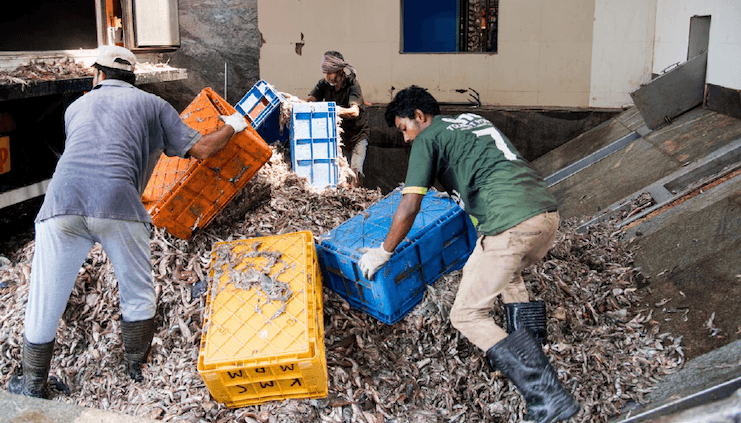 WORK. Workers offload catch at a fishmeal plant in Ullal. Photo courtesy of Changing Markets Foundation
In Senegal, fishmeal has put local fishers out of work, so increasingly they are selling — or repurposing — their boats to flee to Europe, typically taking the roughly 930-mile sea journey to Spain’s Canary Islands, a route that claimed more than 3,000 lives in 2025.
“We’re fishermen, but there’s no fish left here, so we left,” said Cheikhou Omar, a 21-year-old fisher, in September 2024 as he sat on a beach in Senegal, rescued after the fishing boat he took trying to get to Spain capsized, killing two dozen.
The five-year investigation mapped roughly the entire global fishmeal industry, including more than 1,400 fishmeal factories across 64 countries, tracing supply chains from fishing vessels to processing plants, feed mills, fish farms, and seafood retailers. The reporting effort involved dozens of journalists from as many countries, visiting factories and farms and boarding fishmeal ships at sea.
Unsustainable fishing
The oceans bear an especially heavy and largely invisible burden of the fishmeal and fish oil industry. More than a fifth of wild-caught fish around the world is used for non-human consumption, especially as feed for fish, but also chickens and pigs.
The investigation assessed more than 2,400 ships tied to fishmeal production, operating in the waters of at least 30 countries. It found that most of these ships do not fully comply with the Global Charter for Fisheries Transparency, a guide created by leading ocean-focused civil society groups detailing accountability standards for industrial fishing fleets.
For example, less than 30% of the fleet had publicly available location information, and under 25% had a unique vessel identification number, or ship license plate. Such opacity makes the fleet difficult to police.
Scientific studies classified at least half of the species landed by the assessed fishmeal vessels as “overexploited” or worse. Most of the ships in this fleet are purse seiners or trawlers, which deploy vast nets to capture dense schools of fish. Both gear types are associated with high levels of waste, routinely hauling in large volumes of bycatch and non-target species.
At least 165 of the ships in the global fishmeal fleet were bottom trawlers, conducting a particularly destructive form of fishing that uses weighted nets that scrape the ocean floor, destroying virtually everything in their paths.
The problem of unsustainable fishing is compounded by heavy government subsidies that keep too many vessels operating, accelerating pressure on already stressed fisheries.
“Any accounting of the true impact of aquaculture has to start not with the farm, but with the feed,” said Daniel Pauly, project director of the Sea Around Us initiative at University of British Columbia. “And that kind of accounting offers a very different picture than the industry offers.”
The problem with fishmeal
As commodities, fishmeal and fish oil promise to grow in international importance.
Starting in 2022, more than half of the seafood eaten globally came from fish farms rather than wild catch. Aquaculture is a $313-billion industry and the fastest-growing segment of global food production. Most of these fish farms are powered by fishmeal and fish oil.
Fishmeal processing in the Philippines is concentrated in three cities. The first is the port city of Navotas, known as the country’s “fishing capital.” Located in Metro Manila on the island of Luzon, it has at least one fishmeal plant.
The second is Zamboanga, a city on the island of Mindanao regarded as the Philippines’ “sardine capital,” home to half a dozen fishmeal plants. The third is General Santos. The national “tuna capital,” it lies in Mindanao and hosts four fishmeal plants.
Many of these plants focus primarily on processing seafood for human consumption, but they also redirect inedible offcuts into fishmeal. This practice is widely cited as sustainable and socially beneficial, since it uses materials that would otherwise be thrown away.
Therefore, fishmeal production in the Philippines is less of a driver of food insecurity than it is in other countries that use whole edible fish. However, the Philippines suffers from severe food insecurity because of general overfishing and the export of most catch, be it small anchovies or larger species like tuna.
The far greater burden of food insecurity, social unrest, and air and water pollution is borne by the poorer countries that produce the fishmeal or fishmeal-fed seafood the Philippines imports. The country imported more seafood than it produced as of 2023.
Half of all seafood globally is farmed, and most of that is fed fishmeal. The fish farms in several of the countries that export the most seafood to the Philippines — including China, Vietnam, Papua New Guinea, Chile, and Japan — have ties to severe problems caused by fishmeal production, according to the investigation.
Hidden costs
The investigation revealed a surprising diversity of hidden costs in the global feed industry.
In Senegal, fishmeal production accelerated overfishing, eroding traditional fishing grounds and contributing to thousands of young men attempting deadly and desperate voyages at sea to Europe.
In Russia, fishmeal workers were held captive in secluded company towns in remote parts of the country, or stuck on ships far from shore.
“People have nowhere to go, no money,” one worker said in a plea to Russian President Vladimir Putin, who participated in an episode of a call-in television show about the fishmeal plant. “Please, help us,” a second worker said.
In Chile, several hundred protesters burned tires and blocked coastal highways and railway tracks, demonstrating against the early closure of the fishing season, a move partly driven by overfishing tied to fishmeal.
The investigation also unveiled the hidden role of forced labor and land appropriation in China’s growing aquaculture industry. (To be continued) – Rappler.com
The reporting for this story was part of a larger investigation conducted by an international team of journalists based at The Outlaw Ocean Project.