 2 months ago
37
2 months ago
37

Upgrade to High-Speed Internet for only ₱1499/month!
Enjoy up to 100 Mbps fiber broadband, perfect for browsing, streaming, and gaming.
Visit Suniway.ph to learn
When former Senate president Franklin Drilon told us one afternoon that he had no plans of returning to his old life in politics, my mind immediately wandered to Hamilton: The Musical.
One of my favorite parts of that Tony Award winner is the song “One Last Time,” depicting an imaginary conversation — though historically grounded — between first US president George Washington and his secretary of treasury Alexander Hamilton. Even though he faced no constitutional term limits and was expected to win a reelection bid easily, Washington refused a third term.
The song in that musical goes:
(Hamilton) Why do you have to say goodbye?
(Washington) If I say goodbye, the nation learns to move on. It outlives me when I’m gone.
I asked Drilon that afternoon: “But don’t you miss it?”
“Let other leaders do their share. I think I have done my share. I leave my fate to history,” he said.
Many politicians overstay their welcome; Drilon seems to know how — and when — to say goodbye.
A Rappler+ event
Drilon — or Sir Frank as I called him — was our guest at the Rappler office on July 17 for our quarterly town hall with our Rappler+ members. Events like this one allow our loyal subscribers to meet movers of our nation, and even throw questions at them.
Belle, our Rappler+ lead, asked me last month to do the interview, and facilitate the open forum that came after. Even though one-on-one interviews (and with an audience!) are not a journalistic skill that I have mastered, I reluctantly agreed: it meant achieving a KPI, and opportunities to interview someone who has occupied so many of the country’s most important offices don’t often come around.
I knew I had to find time to read his memoir that had been gathering dust in my bedroom since our executive editor Glenda Gloria lent me her copy three or four months ago. Drilon has been a staple in Philippine politics even before I was born in 1996, but I haven’t met him in person since I entered the media profession in 2017. To read his book is to understand the complexities of a man who survived turmoil after turmoil in our young, fragile democracy.

Brush-ins with higher office
In his book and in our conversation, what struck me was a sense of delicadeza that has guided the statesman throughout his career.
Drilon told us a story of how he had been asked by the late former president Noynoy Aquino, after the conclusion of the Renato Corona impeachment trial in 2012, to apply for the vacant chief justice position, but he declined the offer.
“I refused because I said I was perceived to be defending the administration in that proceeding and therefore, for me, to accept the nomination and be appointed, people would say, the reason why you were asking those questions is because you wanted to be chief justice, which was completely not called for, but that would have been the result,” Drilon said.
It’s not the first time this man — who has worn so many hats in government as labor, justice, and executive secretary, as well as the longest-serving Senate president — walked away from a path to higher office.
In his memoir, he talked about the time he came close to becoming president in 2004.
After the national elections that year, there was intense pressure for him as co-presiding officer of the joint session of Congress to delay the proclamation of the winner of the presidential race amid allegations of widespread election cheating. He noted that had no president been proclaimed by June 30, he would have been acting president for 60 days.
“Ultimately, I made the decision to proclaim Mrs. (Gloria Macapagal) Arroyo as president. My reasoning was clear: as acting president, I would lack a popular mandate, and critically, the authority to command the armed forces,” he wrote.
“I never wanted (the presidency). Even when it was practically handed to me, as in 2004, I felt no compelling urge to reach for it,” he added. “The immense burdens of the presidency would remove me from a position of control over the areas that matter most to me as a public servant: lawmaking, representational and constituent service, and addressing ethical and governance issues.”
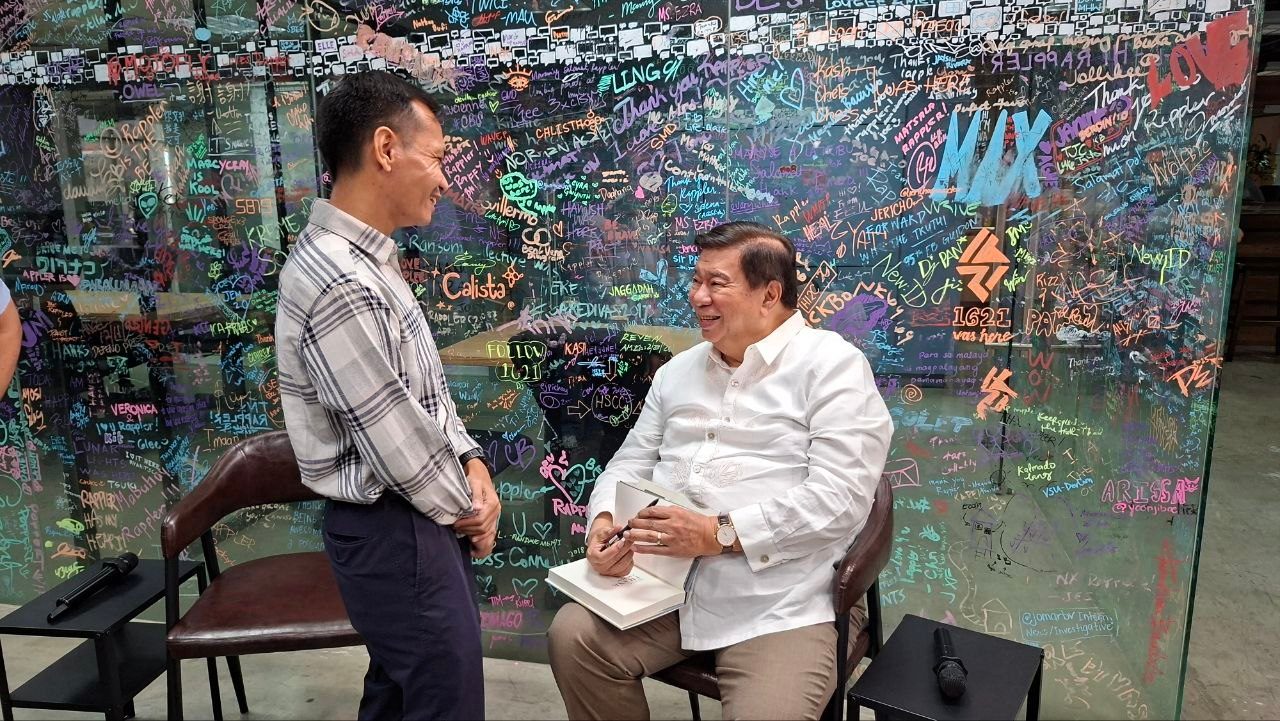 AUTOGRAPH. After the town hall, the writer asked Drilon to sign his copy of the former senator’s book, which was gifted by former tourism chief Narzalina Lim through Rappler head of community Pia Ranada.
Resisting dynasties
The former senator takes pride in being the only Drilon in politics. It is striking how a man who has all the political infrastructure to establish a dynasty chose not to.
Curbing the concentration of political power in a handful of families remains one of the unfulfilled promises of the 1986 EDSA People Power Revolution. The 1987 Constitution prohibits political dynasties, but in the absence of an enabling law, elective office has largely remained a family affair.
It’s a hot-button issue these days as the House passes a bill defining dynasties. Its loose provisions, however, raise fears that the proposal will legitimize dynasties instead of regulate them. Given the composition of Congress, it’s unsurprising that proposals to regulate political dynasties stop short of meaningfully limiting them.
I think — and I say this with all due respect to the lawmakers I have been covering for a number of years now — that politicians, including those who truly believe they are some of the few good ones, should disabuse themselves of the notion that the country’s future rests solely in their hands.
No single family has the monopoly on good governance. Democracies are sustained by institutions and their people, not by messiahs.
![[FIRST PERSON] An afternoon with Frank Drilon](https://img.youtube.com/vi/YdM7pFgYd5c/sddefault.jpg)
Finding hope
Drilon’s retirement does not mean complete disengagement from politics. These days, he makes media appearances to speak his mind about the country’s affairs.
He’s monitoring Vice President Sara Duterte’s impeachment trial, but admits even he gets “bored” by the very technical nature of the proceedings. He called on Senate President Win Gatchalian and presiding officer Chiz Escudero to “exercise more authority” so people won’t be fatigued by trivialities, such as the lengthy debate over the legitimacy of Duterte’s video threat which the entire country already knew happened.
Drilon also said he’s part of a group of 10 people trying to convince former vice president Leni Robredo to give the presidency another shot.
“At a certain point, (former) vice president Leni was no longer responding to my text messages. We respect her for that. We have not at this point identified any other candidate because, as I said, one week is too long in politics,” he said.
Much of that Rappler+ town hall revolved around today’s political actors: who should be held accountable, who should run, what the Senate should be doing. Before we wrapped up, I asked him something broader. How can a man — who first entered government in 1987 as deputy labor minister and with an optimism to do his share in rebuilding democracy — not give in to the cynicism that has struck other Filipinos?
The family that was ousted by the 1986 revolution, after all, has returned to Malacañang.
“I keep on telling my friends, my children, we should not give up because this is our country. I must admit that there are times when I myself get disillusioned. But you wake up to the fact that this is your only country,” he said.
“We can’t rely on anybody else. At the end of the day, this is our country and we face and we suffer the consequences of erroneous decisions that we make as a people.” – Rappler.com