 7 months ago
137
7 months ago
137

Upgrade to High-Speed Internet for only ₱1499/month!
Enjoy up to 100 Mbps fiber broadband, perfect for browsing, streaming, and gaming.
Visit Suniway.ph to learn

PROBE. DPWH Secretary Vince Dizon files malversation and graft charges against 22 officials and contractors allegedly involved in irregular infrastructure projects in Davao Occidental and La Union, at the Office of the Ombudsman on October 23, 2025. He is joined by Ombudsman Remulla and ICI Chair Andres Reyes in a press conference following the filing of the complaints.
Jire Carreon/Rappler
Historically, the House has not always been receptive to SALN requests. This has also been the practice of other branches, like the executive and the judiciary.
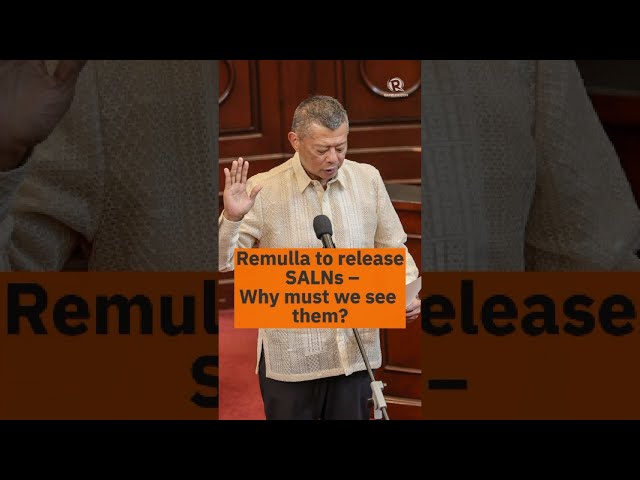
Ombudsman Jesus Crispin “Boying” Remulla sounded the alarm over the limited access to lawmakers’ Statements of Assets, Liabilities, and Net Worth (SALN) amid the ongoing flood control corruption probe.
Remulla, who assumed office in 2025, said his investigating teams are facing difficulties in accessing what are supposed to be public documents.
“May mga sinasabi sa team namin na padadaanin pa raw sa plenary ‘yong permission. Walang gano’n eh, hindi dapat padaanin sa plenary. Nasa Congress ako dati (Our team was saying that the permission to access SALNs needs to go through the House’s plenary. There’s no such thing, the request should not go through plenary. I was in Congress before,” the former lawmaker-turned-Ombudsman said.
As the primary anti-graft body, the Ombudsman is on top of the investigation into the multi-billion flood control corruption that allegedly involves not just private contractors, but also high-ranking officials like members of the House of Representatives and senators.

SALNs are important because they contain the summary of a government official’s wealth and liabilities. These documents also serve as aid for investigators who do lifestyle checks or who look into possible ill-gotten wealth.
In short, SALNs are there to spot possible red flags in the properties of government officials and employees, and to ensure that they are living within their means.
If this is the case, why does even the Office of the Ombudsman — a powerful constitutional body tasked to combat corruption — find it difficult to get a hold of these documents?
What are the rules?
The annual submission of SALNs is mandated by section 17, article XI of the 1987 Constitution, as well as Republic Act (RA) No. 6713, or the Code of Conduct and Ethical Standards for Public Officials and Employees.
Under the Civil Service Commission’s (CSC) SALN guidelines, the following offices serve as custodian of these documents:
- Ombudsman: President, Vice President, constitutional commission heads and officials
- Secretary of the Senate: Senators
- Secretary of the House: House members
- Supreme Court’s Clerk of Court: Justices
- Office of the Court Administrator: Judges
- Office of the President: Cabinet members, undersecretaries, assistant secretaries, etc.
- Deputy Ombudsman for Luzon, Visayas, and Mindanao: Regional officials of government offices, and provincial and city/municipal officials
- Civil Service Commission: All other government officials
Are SALNs open to public?
Laws mandate the release of SALNs to the public.
Article XI, section 17 of the Constitution states that “declaration (SALN) shall be disclosed to the public in the manner provided by law,” while RA No. 6713’s section 8(d) allows access to SALNs as long as it’s for “news and communications media for dissemination to the general public.”
But despite these legal bases, access to SALNs is based on the discretion of their custodians. Most of the time, access to these documents is not granted. While in some cases, the owners of the SALNs themselves volunteer to disclose theirs to the public.
The SC affirmed that the release of SALNs may be discretionary through a 2021 ruling that said public access to SALNs may be regulated.
“A custodian such as the Office of the Ombudsman is not bound under every circumstance to allow or to grant the request of disclosure of a public official’s SALN to the public. A custodian is not prohibited by the Constitution to regulate such disclosure,” the High Court said.
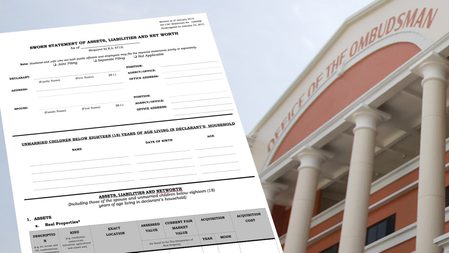
Some SALNs are currently available at the Ombudsman’s, but as stated in the CSC guidelines, not all disclosures are there.
In fact, at one point, Duterte-time ombudsman Samuel Martires even barred access to SALNs under his office from 2018 until his retirement in 2025. When Remulla assumed office in 2025, he lifted this memorandum and allowed access to SALNs anew.
The House’s practice
Historically, the House has not always been receptive to SALN requests. This has also been the practice of other branches, like the executive and the judiciary.
After the 2012 ouster of the late former chief justice Renato Corona, who was impeached for his failure to declare some properties, the government has become extra cautious in releasing SALNs.
The Supreme Court restricted the release of SALNs to protect justices and judges from harassment, while some lawmakers became more averse to disclosing their wealth. In 2012, then-House speaker Feliciano Belmonte Jr. even reiterated that requests for SALNs should be directed to the individual lawmakers themselves.
In the context of the flood control corruption, some legal experts like former Philippine Bar Association president Rico Domingo said the Ombudsman may issue subpoenas to access the SALNs of lawmakers allegedly involved in the mess.
“He (Remulla) has a basis. Under his charter, the Ombudsman Act, he has a basis for requesting the SALNs of the people they’re investigating…And the Senate and or the House will not be able to reject or decline because the Ombudsman has the power to subpoena all the SALNs,” Domingo said in a mix of Filipino and English in a DZMM interview.
But based on the experience of some prosecutors during the pork barrel scam, the issuance of subpoenas was no assurance. Even with this legal document, SALN requests for House members still went through the Speaker’s office, and then to the plenary for approval. There were also instances where some prosecutors never got the SALNs they requested for at all.
For Remulla, the House should cooperate with them for a faster probe.
“Just cooperate. Ayaw naming makasakit ng tao, gusto namin maiayos lang ang bansa (We don’t want to hurt anyone, we just want to fix our country),” the Ombdusman said.
Speaker Bojie Dy said in September 2025 that he is willing to make his SALN public, and he fulfilled this promise the following month. Under Dy, will the House change its mind and be open as well to release other lawmakers’ SALNs? – Rappler.com