 9 months ago
137
9 months ago
137

Upgrade to High-Speed Internet for only ₱1499/month!
Enjoy up to 100 Mbps fiber broadband, perfect for browsing, streaming, and gaming.
Visit Suniway.ph to learn
Already have Rappler+?
to listen to groundbreaking journalism.
This is AI generated summarization, which may have errors. For context, always refer to the full article.

ANTI-CORRUPTION SUMMIT. Procurement Service - Department of Budget and Management chief Genmaries Entredicho-Caong joins a panel on procurement integrity at the 11th Session of the Conference of the States Parties to the United Nations Convention against Corruption on December 15, 2025.
United Nations Office on Drugs and Crime
At a high-level corruption summit of the UN, the Philippines expresses hopes that procurement reforms will help prevent a repeat of the flood control corruption scandal
DOHA, Qatar – At the high-level anti-corruption summit of the United Nations in Doha, Qatar, the Philippines emerged as a poster boy of procurement reform, even though the impact has yet to be significantly felt back at home.
The Philippines organized and led on Friday, December 19, a panel on digital inclusion and innovation in procurement, with speakers that included Procurement Service-Department of Budget and Management (PS-DBM) chief Genmaries Entredicho-Caong and Sandiganbayan Presiding Justice Geraldine Faith Econg.
Filipino delegates boasted developments after the Philippines passed in 2024 the New Government Procurement Act (NGPA), which institutionalized electronic bidding and sought to reduce procurement time.
These include a centralized e-marketplace for common-use supplies, end-to-end digital procurement through the Philippine government’s electronic procurement system, and interoperable databases across regulatory agencies.
“This law is very important to us in the anti-corrupt world, as we pin our hopes that this digitalization of the procurement process will result in less cases to land in the courts. Currently, majority of the cases that we try involve graft and corruption in the procurement of goods and services, civil works, and consultancy,” Econg said.
Entredicho-Caong, who had spoken at a procurement-related panel two days earlier, also touted the awards that the Philippines won in the Open Government Partnership in October over its “commitment to improve data availability, interoperability, and public participation in procurement,” even though some budget experts from civil society said the recognition did not reflect realities on the ground.
“When we submitted this entry in February, the investigations into the flood control scam have not started yet,” Entredicho-Caong candidly told the audience.
The Philippine delegation here isn’t one to shy away from mentioning the ongoing corruption scandal that has gripped their fellow citizens. The firestorm has already been linked to President Ferdinand Marcos Jr. himself, although the delegation focused on what his administration is doing to go after those implicated.
In his plenary speech on Monday, December 15, Philippine delegation head Ombudsman Boying Remulla even said the government has acted quickly to file charges against high-level officials.
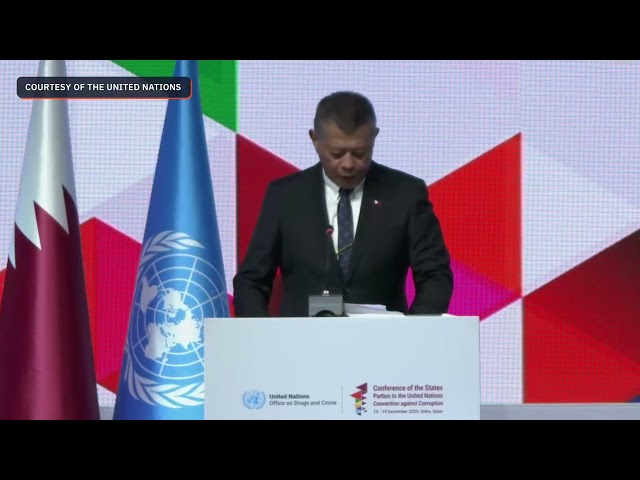
Speaking to Rappler after her panel on Friday, Entredicho-Caong expressed hope that government efforts to enact procurement reforms will help prevent corruption schemes similar to that of the flood control fiasco.
She even cited as an example the case of couple-contractors Sarah and Curlee Discaya, who admitted in a Senate inquiry that they owned nine construction firms.
“Upon a review of the documents that they maintain with the Securities and Exchange Commission, it appears that two out of the nine firms, they are not the declared beneficial owners. So the consequence was our SEC has revoked the registration of these two companies,” Entredicho-Caong said in her panel presentation.
She said the reforms will make it easier for the public to flag conflict of interest that may arise from the awarding of these projects.
“Our open data portal is visible to the public. There is now a requirement for a beneficial ownership registry that is accessible to the public, and this will be published on PhilGEPS. That is what we are waiting for,” Entredicho-Caong said.
“Once we receive authority from the Government Procurement Policy Board to publish it on PhilGEPS, we will make public whatever data we already have,” she added.
Currently, the PhilGeps website remains clunky, complicating journalists’ efforts to locate government contracts.
While the new procurement law became effective in August 2024, the three-year transitory period only began this year.
This means that all procuring entities have until 2028 to comply with requirements set by the NGPA.

– Rappler.com
How does this make you feel?
Loading