 54 minutes ago
2

Upgrade to High-Speed Internet for only ₱1499/month!
Enjoy up to 100 Mbps fiber broadband, perfect for browsing, streaming, and gaming.
Visit Suniway.ph to learn
“When you look at this gold jewelry, you realize that once upon a time we had a golden age. It gives you a sense of what was pre-colonial culture,” historian Ambeth Ocampo tells Rappler
Gold is a patient metal. It does not rust or decay. It can be melted, worn, used, and reused from one generation to another, surviving long after the hands that first fashioned it have turned to dust.
And more than a thousand years ago, long before these islands were called the Philippines, our ancestors were already working gold into exquisite ornaments, delicate chains, and elaborate vessels. Some of these treasures have survived to the present day; in them, we see a glimpse of a civilization nearly forgotten.
Their rediscovery was a golden accident.
On a sunny April day in 1981, Edilberto “Mang Berto” Morales was operating heavy machinery for a government irrigation project in Surigao del Sur. Something glistened in the mud.
What he mistook for a helmet turned out to be a partly crushed gold bowl. Suspecting more, he shooed away his coworker and searched alone, combing some 300 feet of earth until late afternoon.
By day’s end, he had recovered around 22 pounds of ancient gold, including an extraordinary necklace he called kuwintas ni nanay (mother’s necklace.) He hid the long chain around his waist, beneath his shirt, away from curious eyes.
Now in the Bangko Sentral ng Pilipinas (BSP) collection, it consists of 12 individual kamagi necklaces joined end to end, their intricate links resembling one woven cord.
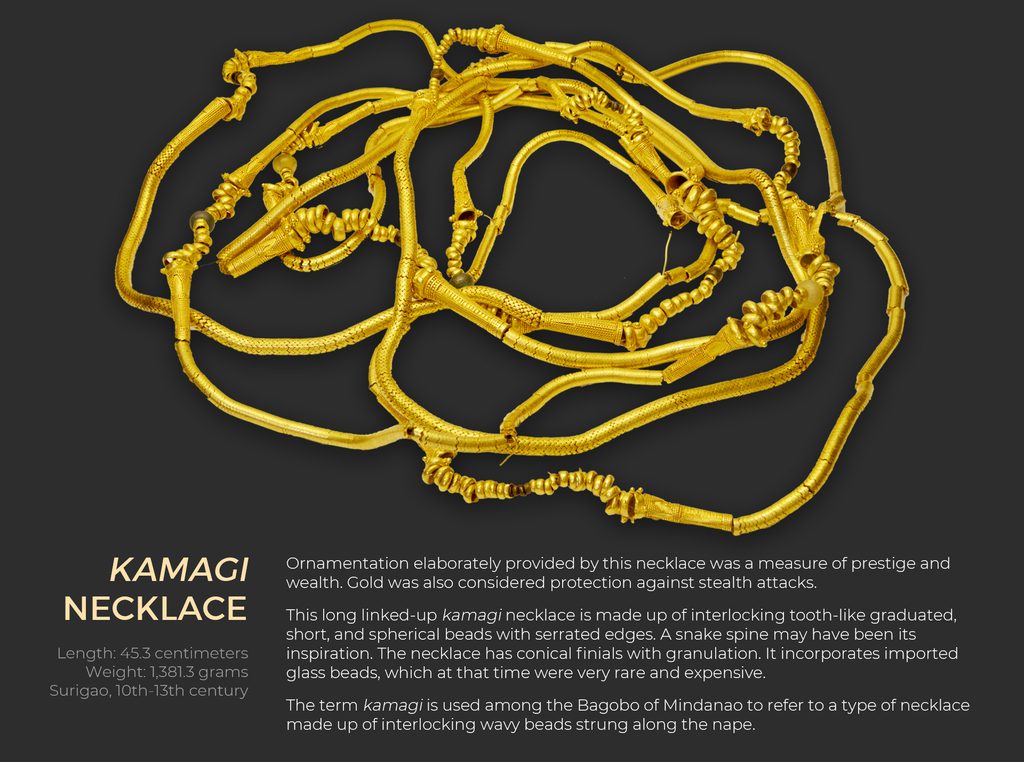 Photo from the Bangko Sentral ng Pilipinas
But the treasure began to scatter almost as soon as it emerged. Treasure hunters recovered more gold, dispersing objects among collectors and separating pieces of the same ornament.
Then-central bank governor Jaime Laya and collectors Leandro and Cecilia Locsin helped preserve significant portions, which entered the collections of the BSP and Ayala Museum.

Bahandi sa Atong Kagahapon
Florina Capistrano-Baker, the scholar behind the newly launched book Bahandi, calls the two collections as “twins separated at birth.”
“They preserve different parts of a shared history and even different parts of what was once one object,” she said on Thursday, October 22, during the book’s launch at the BSP.
In 2024, selected pieces were reunited at Ayala Museum, where the exhibition is scheduled to run until 2027.
And what a magnificent history they reveal. Ancient goldsmiths mastered techniques involving minute golden beads, delicate filigree, and interlocking chains so precise that the finished jewelry could resemble cloth.
“Even today, they cannot [recreate] some of it,” historian Ambeth Ocampo told Rappler in an exclusive interview, saying that ancient Filipinos possessed such a sophisticated understanding of gold that they even had distinct terms for its purity, including 24-carat and 20-carat gold.
Gold also proclaimed status. The wealthy could wear numerous chains around their necks, with some ornaments so heavy that their wearers were said to stoop beneath their weight, BSP Deputy Governor Bernadette Romulo-Puyat recounted in a separate interview with Rappler.
Yet these were more than displays of extravagance.
 PAST. Florina Capistrano-Baker tells the crowd about the treasures that help us understand what a pre-colonial Philippines was like. Photo by Lance Spencer Yu/Rappler
“These are not just splendid ornaments. They’re evidence of social stratification, craft specialization, technical knowledge, and affluent individuals who had the means to commission these luxury goods,” Capistrano-Baker explained.
The treasure also points toward ancient Butuan, whose communities traded across the seas long before Spanish colonization. Their surviving goldwork bears influences shared with Java and other parts of South and Southeast Asia, suggesting a world of exchange far richer than conventional colonial histories might suggest.
For Ocampo, the gold offers a rich rebuttal for Filipinos raised on histories that often begin with the arrival of foreigners.
“When you look at this gold jewelry, you realize that once upon a time we had a golden age,” he told Rappler. “So it gives you a sense of pride, gives you a sense of what was pre-colonial culture.”
At the launch of Bahandi, BSP Governor Eli Remolona likened the generations who made, discovered, and preserved the treasure to links in a kamagi.
“May future generations find their place in the chain and ensure it never breaks,” he said. – Rappler.com