 1 hour ago
1
1 hour ago
1

Upgrade to High-Speed Internet for only ₱1499/month!
Enjoy up to 100 Mbps fiber broadband, perfect for browsing, streaming, and gaming.
Visit Suniway.ph to learn
Already have Rappler+?
to listen to groundbreaking journalism.
This is AI generated summarization, which may have errors. For context, always refer to the full article.
![[Ask the Tax Whiz] When fuel excise taxes pause](https://www.rappler.com/tachyon/2026/04/fuel-subsidy-shell-gas-station-pasig-city.jpeg)
DISCOUNTED FUEL. Shell station in Pasig City provides government discounted fuel for jeepney and UV drivers on April 14, 2026.
James Patrick Cruz/Rappler
The Philippine Tax Whiz breaks down recent Bureau of Internal Revenue (BIR) issuances that have drawn public attention as fuel prices continue to affect households and businesses in the Philippines
In response to rising energy costs, the government implemented a temporary suspension of excise tax on liquefied petroleum gas (LPG) and kerosene through Revenue Regulations (RR) No. 3-2026, with implementing guidelines issued under Revenue Memorandum Circular (RMC) No. 31-2026.
Background: How the excise tax suspension started
The suspension is part of the government’s broader response to sustained increases in global oil prices affecting Filipino households. In March 2026, Republic Act No. 12316 was enacted, granting the President authority to temporarily suspend or reduce excise taxes on fuel once certain global price conditions are met. The law took effect 15 days after publication, which explains the timing of its implementation in April.
Following this, Executive Order No. 114, issued on April 16, 2026, formally directed the suspension of excise taxes on LPG and kerosene. The order was based on recommendations from economic managers, citing persistent high oil prices and their impact on basic household expenses.
1. What petroleum products are covered by the suspension, and when does it take effect?
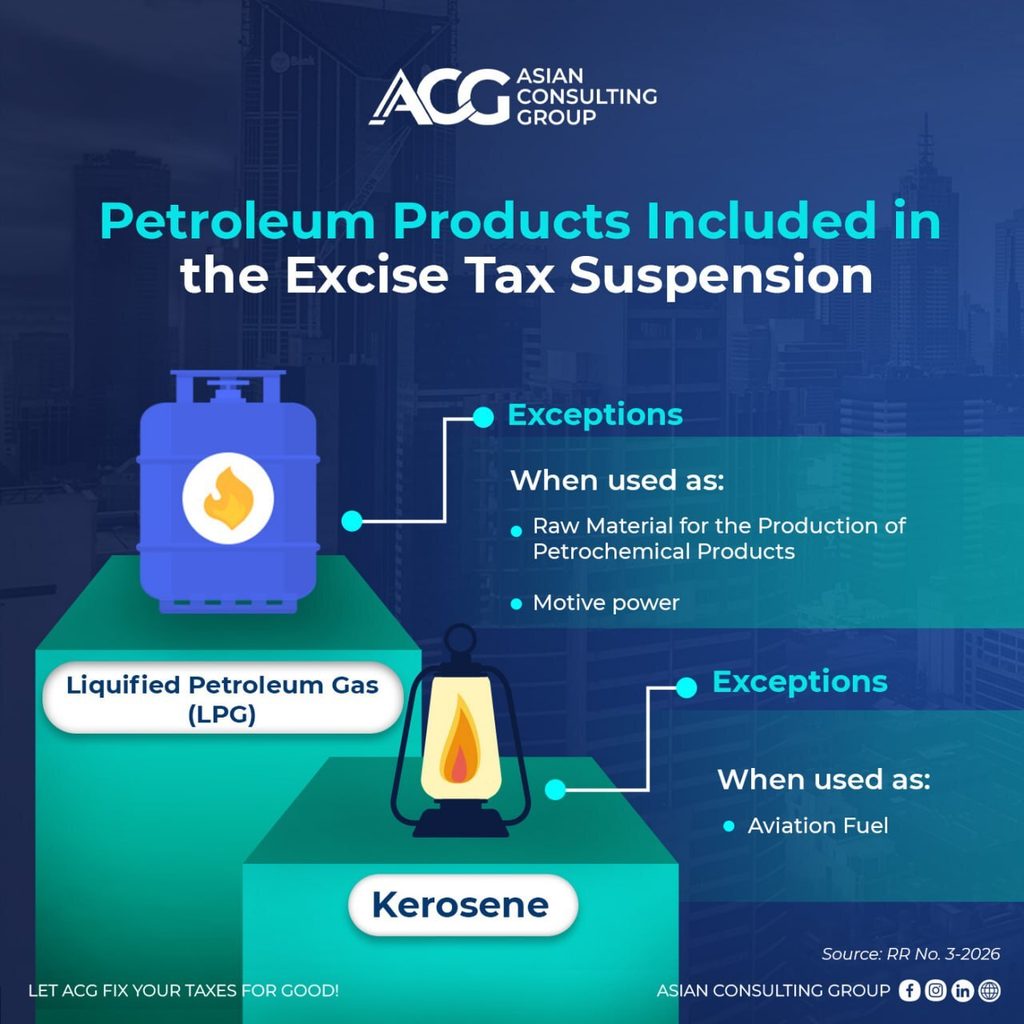
Starting April 17, 2026, the imposition of excise tax on certain petroleum products is temporarily suspended. This covers the following:
2. How should businesses treat this for tax compliance?
For taxpayers such as importers, distributors, and sellers, compliance remains critical even during the suspension.
Under RR No. 3-2026, as clarified by RMC No. 31-2026, businesses must still:
- Properly classify LPG and kerosene as covered products
- Identify which transactions qualify for the suspension
- Maintain complete supporting documents
- Reflect the correct treatment in books of accounts and tax filings
RMC No. 31-2026 plays a key role in ensuring that the rules are applied consistently across all BIR offices.
3. If excise tax was already paid during the suspension, can it be refunded?
Not automatically.
Taxpayers must establish that:
- The transaction falls within the coverage and timing of the suspension
- The excise tax was paid on transactions that should have qualified for suspension
- All supporting documents are complete and compliant with BIR requirements
Refunds or tax credits remain subject to standard BIR procedures and verification. This means taxpayers must actively file and substantiate their claims.
4. How long will the suspension of excise tax on LPG and kerosene last?
The suspension shall last for three months from the effectivity of Executive Order (EO) No. 114 and will be subject to monthly review by the Development Budget Coordination Committee (DBCC).
However, it is not fixed, as the government will review the situation every month and may either extend the suspension, modify it, or lift it earlier depending on conditions. Once the suspension is lifted, excise taxes will automatically return to the rates under the Tax Code, without the need for a new law.
Final takeaway
RR 3-2026 and RMC 31-2026 are part of the government’s response to real economic pressure caused by rising fuel and energy costs, particularly affecting households relying on LPG and kerosene. It is emphasized that the measure is a suspension of excise tax collection and not a repeal or removal of the tax imposed under the Tax Code.
For taxpayers and businesses, the focus is not only on understanding the relief, but on ensuring correct application, documentation, and compliance. Because in taxation, especially during times of economic pressure, clarity is not just helpful — it is essential protection. – Rappler.com
Mon Abrea is a Global Tax Policy Expert and Chief Tax Advisor of the Asian Consulting Group (ACG), the Philippines’ premier tax advisory and investment consulting firm—providing tax strategy, compliance, and policy advisory services to multinational corporations, foreign investors, and government institutions. For strategic tax advisory, CONSULT ACG, or you may also send an email to consult@acg.ph to host investment and tax briefing in key cities across Asia, Middle East, Oceania, Europe and North America.
How does this make you feel?
Loading