.png) 2 months ago
38
2 months ago
38

Upgrade to High-Speed Internet for only ₱1499/month!
Enjoy up to 100 Mbps fiber broadband, perfect for browsing, streaming, and gaming.
Visit Suniway.ph to learn
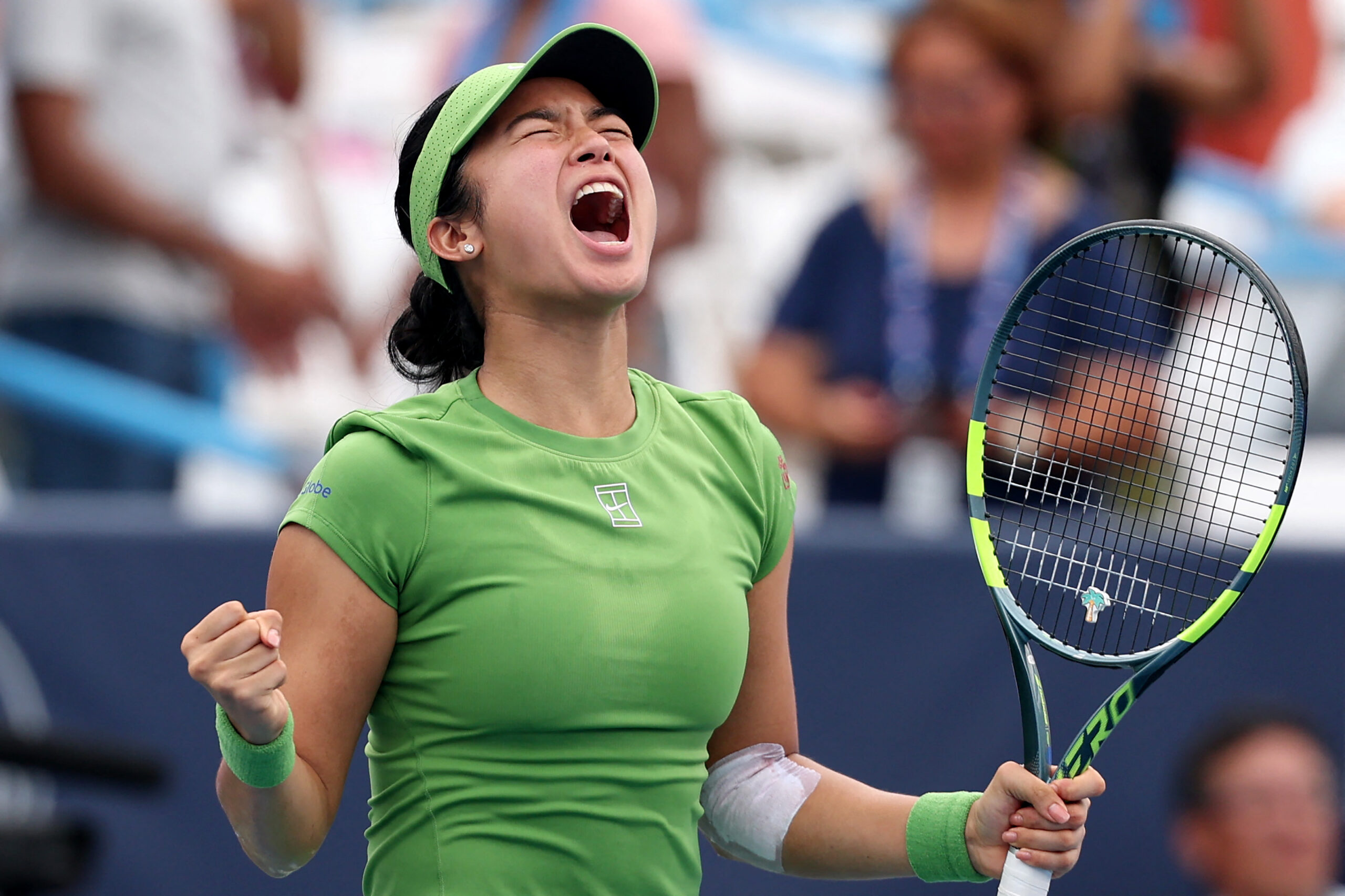
Alexandra Eala of the Philippines celebrates after winning a women’s singles match against Naomi Osaka of Japan on day six of the Mubadala DC Open 2026 at William H.G. FitzGerald Tennis Center on August 01, 2026 in Washington, DC. Emilee Chinn/Getty Images/AFP
At one point during her semifinal match, Alex Eala absorbed a near-200-kph first serve from Naomi Osaka and then swung a backhand return that stunned even TV analysts.
Osaka could only smile as Eala turned her foe’s own power against her to win the point.
And that wasn’t just some lucky reflex swing—it was by design.
As scrutiny continues on her service game, the Filipino superstar has found her own winning blueprint against some of the sport’s biggest names: Elite returns.
“It really depends on the moment because there are so many factors when it comes to returning,” Eala said, explaining her mental process in dealing with powerful servers in a post-match interview with the Tennis Channel after her 6-4, 6-2 victory over Osaka on Sunday.
The Philippines will wake up to either toasting Eala as champion or the Filipinos celebrating their heroine’s biggest ever WTA 500 finish as the 21-year-old was slated to play American Jessica Pegula very early Monday in Manila.
“What’s the situation? What are you looking for in the ball? And at the end of the day, you don’t know what serve is going to come at you, right?” she added.
Eala won 27 of the 59 points (46 percent) played on Osaka’s serve while the Japanese-American ace won only 12 of 47 return points (26 percent).
Eala’s performance against Osaka’s first serve was even more eye-catching. She won 13 of 32 first-serve return points (41 percent)—of the 19 points she lost, five were aces, meaning she won 13 of Osaka’s 27 playable first serves. That limited the four-time Grand Slam champion to a 59.4-percent success rate on her first serve.
“[Y]ou kind of have to be ready for anything. But … whatever I can control, I try to do my 100 percent,” Eala said.
A big part of Eala’s return game is her ability to take the ball early, shortening Osaka’s reaction time after her big serves. The sustained pressure of Eala’s returns produced 12 break chances, four service breaks and a 27-12 advantage in return points won.
“I played really well and I had a great mentality and I stayed locked in until the end,” Eala said.
Eala, set to jump to a career-best 24th in the world rankings, had previously ousted second seed Elina Svitolina for her sixth top-10 victory of the year after dethroning defending champion Leylah Fernandez.
It was the first meeting of the Asian stars, Eala facing one of the idols of her youth.
“She definitely has aura and she definitely has power,” Eala said of Osaka. “I remember watching her finals in the Australian Open and US Open so really a great experience to share the court with her and I’m really happy I was able to produce that level against her.”
Despite her recent run of success, Eala said she hasn’t lost sight of her goal to constantly improve her game.
“There are so many things [that keep me grounded],” she said. “My family keeps me grounded. My team keeps me grounded.
“Every error I hit on the court keeps me grounded. Every time I’m mad on the court keeps me grounded. When I wake up in the morning, I have bad hair and it keeps me grounded.”
“I’m 21, so it’s not like I’m the queen of the world or anything,” Eala added.
Subscribe to our daily newsletter
Maybe not, but her return game is nothing short of royalty. —with reports from AFP and INQUIRER SPORTS DESK INQ