 4 months ago
71
4 months ago
71

Upgrade to High-Speed Internet for only ₱1499/month!
Enjoy up to 100 Mbps fiber broadband, perfect for browsing, streaming, and gaming.
Visit Suniway.ph to learn
MANILA, Philippines – As artificial intelligence rapidly reshapes workplaces, government services, and labor markets worldwide, Philippine researchers and labor experts are warning that many local government units remain unprepared for the transition, raising concerns that AI could deepen existing inequalities instead of narrowing them.
During a webinar organized by the Philippine Institute for Development Studies (PIDS), researchers, labor specialists, and economists highlighted how gaps in infrastructure, technical capacity, governance, and digital literacy continue to constrain AI adoption in the country, particularly outside major urban centers.
A PIDS study published in December 2025 (“How Ready Are LGUs for AI Adoption?”) found that most Philippine LGUs exhibit only “low to moderate” readiness for AI integration, citing weak internet infrastructure, limited ICT staffing, and insufficient funding for digital transformation.
The study, headed by PIDS senior research fellow Francis Mark Quimba, assessed local governments using an AI Readiness Index that measured digital infrastructure, human capital, governance, innovation ecosystems, and economic foundations. The index is based in part on the latest available data from a comprehensive survey conducted by the DICT in 2023.
Researchers found significant disparities between regions.
“Most of the regions in Visayas and Mindanao have average AI-readiness scores in the low-to-mid 30s,” the study stated, while more developed regions in Luzon, particularly NCR, posted higher scores. The Bangsamoro Autonomous Region in Muslim Mindanao (BARMM), Eastern Visayas, the Cordillera Administrative Region, and Mimaropa recorded some of the lowest readiness scores nationwide.
This digital divide is underscored by gaps in internet coverage — a persistent problem that has hounded the Philippines for a long time, and one that is currently being addressed with laws such as the Konektadong Pinoy Act, whose implementing rules and regulations (IRR) were finalized in November 2025.
“Internet coverage emerges as the most severe weakness across all island groups,” the study noted — a weakness that it calls a “critical bottleneck” in the age of AI, with “last-mile connectivity” to the actual barangays still a significant gap.
Researchers also flagged low internet speeds and inadequate ICT equipment across all regions, limiting the ability of local governments to deploy sophisticated AI systems.
“Bandwidth constraints severely limit the types of AI applications that can be deployed,” the study said. “Sophisticated AI systems requiring real-time data processing, computer vision, or large language models demand high-speed connections that current infrastructure cannot support,” it warned.
Beyond infrastructure, researchers warned that many local governments lack the long-term planning and sustained investments needed to support AI adoption.
“ICT budget allocation presents perhaps the most alarming finding in the entire assessment,” the paper stated, noting that local governments across all income classes allocated small portions of their budgets to ICT development.
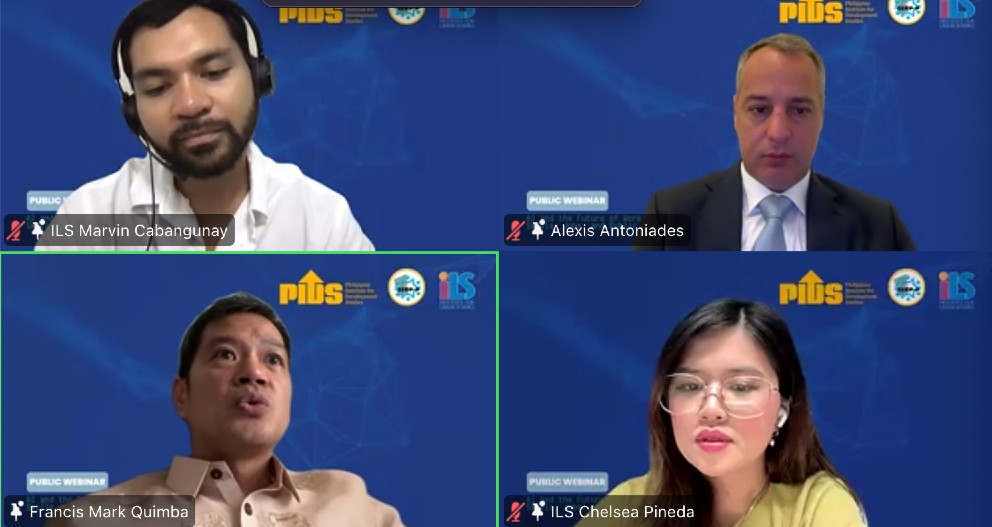 PIDS WEBINAR. Marvin Cabangunay, Institute for Labor Studies, Department of Labor and Employment (DOLE-ILS), and professor Alexis Antoniades, Chair of International Economics at Georgetown University in Qatar (top), Dr. Francis Mark Quimba, Senior Research Fellow at PIDS,
and Chelsea Nicole Pineda, Senior Labor and Employment Officer at DOLE-ILS (bottom) discuss the implications of AI on the workforce
.
AI may widen inequalities
The webinar also examined how AI could reshape labor markets and potentially worsen socioeconomic inequality if governments and institutions fail to respond proactively.
Professor Alexis Antoniades of Georgetown University in Qatar warned that inequality was already rising globally even before widespread AI adoption.
“We do have inequality rising and we see that if you look at the income distribution, the middle class starts to disappear. AI will only accelerate that,” Antoniades said.
He noted that technological transitions historically tend to reward workers and firms with stronger access to capital, education, and digital infrastructure.
Antoniades pointed to how business-service wages in dense urban centers have risen faster than those in rural areas, partly because technologically intensive industries cluster in cities.
Researchers warned that if AI-related investments remain concentrated in major cities while poorer local governments continue struggling with internet access and staffing shortages, existing regional and class disparities may intensify.
Antoniades also compared the current system to the aristocracies of the past: “So what is happening? It’s a very naive example, but think of those, the aristocracy in the old times, they controlled the land and everybody worked for those land owners. Now we have the people that control the AI machines that create power that everybody needs to use… all the revenue will be going into those AI machines, and the machines will be doing the work that human beings used to do.”
The disparity is tied directly to life satisfaction, the professor emphasized: “Of course, we care about income disparities because higher income is linked to higher life expectancy, lower child mortality, lower maternal death, more life satisfaction, more years of schooling, less hours work.”

Evidence-based policymaking
Despite the challenges, speakers emphasized that AI adoption should not simply be viewed as a technological race, but as a governance and development issue requiring evidence-based policymaking.
Quimba outlined several policy recommendations to improve AI readiness among local governments in the Philippines.
First, they called for removing regulatory barriers to digital infrastructure development, including eliminating legislative franchise requirements for connectivity providers — something that Konektadong Pinoy addresses — and updating other telecommunication laws that are “outdated” such as RA 7925 and the Radio Control Law.
Second, they recommended integrating AI and data literacy into the education system from K-12 to higher education and Technical Education and Skills Development Authority programs, and investing in teacher training capacity. Third, they emphasized the need for a more coordinated national AI strategy, while acknowledging the Department of Science and Technology’s existing AI roadmap as a positive step.
Fourth, the speaker proposed mandating minimum ICT budget allocations for local governments, starting at 2% of local budgets for digitalization and eventually increasing to 3%, with compliance tied to eligibility for national grants and performance-based transfers.
Fifth, they recommended establishing a national data governance framework under the Philippine Statistics Authority (PSA), including standards for data collection, sharing, privacy, and a centralized portal accessible to authorized researchers and regulators. Lastly, the speaker proposed creating a National LGU AI Readiness Fund designed to help poorer municipalities catch up in AI adoption and digital capacity.
Human-centered transition, soft skills
While much of the discussion focused on technical readiness and digital literacy, speakers ultimately emphasized that soft skills and human-centered approaches may matter even more in an AI-driven economy.
Chelsea Nicole Pineda, senior labor and employment officer at the Department of Labor and Employment-Institute for Labor Studies, argued that employers increasingly value adaptability, communication, leadership, and problem-solving skills.
“Nothing could really replace the soft skills,” she said.
Pineda said workers must cultivate “an attitude towards lifelong learning” because labor markets and technologies are changing rapidly.
“The technology that we know now could be different by next year, even in the next 10 years or by 2050,” she said.
Antoniades likewise said the rise of AI has made soft skills even more valuable.
“Some other people that studied finance and they had masters… but they lacked the communication skills and they failed. So soft skills are actually becoming even more important now that the technical barrier has broken,” he said.
Quimba meanwhile stressed the broader social role of schools and institutions in preventing inequality.
“Schools are actually the means for students who don’t have access to AI, to the tools, to be able to gain access,” he said.
He added that educational institutions can help reduce inequality by strengthening emotional intelligence, discipline, creativity, and access to digital resources among marginalized students. The challenge facing the Philippines is no longer simply whether AI will arrive, but whether institutions and communities can adapt quickly enough to ensure that technological progress remains inclusive. – Rappler.com