 5 months ago
41
5 months ago
41

Upgrade to High-Speed Internet for only ₱1499/month!
Enjoy up to 100 Mbps fiber broadband, perfect for browsing, streaming, and gaming.
Visit Suniway.ph to learn
Already have Rappler+?
to listen to groundbreaking journalism.
This is AI generated summarization, which may have errors. For context, always refer to the full article.
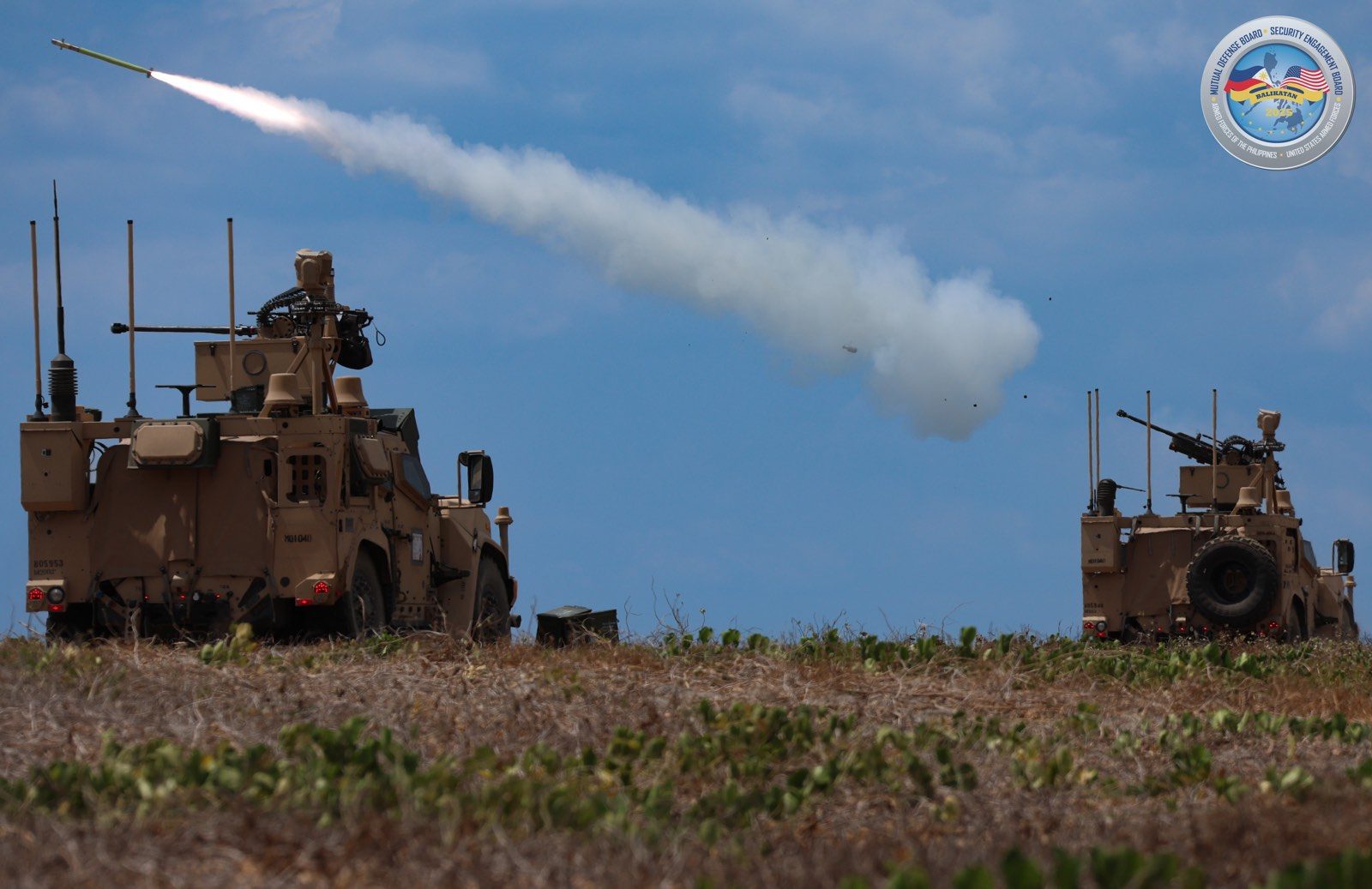
FIRING. US Marine Air Defense Integrated System fires during the Integrated Air and Missile Defense Drill as part of Exercise Balikatan 41-2026 on April 28 at Naval Station Leovigildo Gantioqui, San Antonio, Zambales.
AFP PAO
In Zambales, Philippine and American soldiers practice what they would do if enemy forces enter the Philippine airspace
ZAMBALES, Philippines — After an hours-long lull and with nary a warning, the United States Marine Corps launched a missile that flew from the shore into the air, hitting a drone they had released minutes earlier.
A quick round of applause erupted from a small team of American and Filipino soldiers keeping watch of the drills from a concrete tower. It was a perfect hit.
The targeting of drones along the coast of Zambales was the penultimate sequence on the third day of the Integrated Air and Missile Defense (IAMD) demonstration at Naval Station Leovigildo Gantioqui in Zambales, one of many major drills under the Balikatan 2026 war games.
“It is important for us to enhance our interoperability with regard to fighting or defending our airspace or our country,” Major Richmond Jan Cayabyab, battery commander of the SPYDER (Surface-to-air PYthon and DERby) air defense system, told reporters on Tuesday, April 28.
The four-day activity was meant to simulate how units from the United States and the Philippines could work in tandem to deter or fight off enemy air assets flying too close to the Philippines.

Cayabyab said several systems were used during the activities — the Philippine Air Forces’ SPYDER, the United States Marine Corps’ Marine Air Defense Integrated System (MADIS), and the US Army’s AN/TWQ-1 Avenger Air Defense System, among others.
Personnel from the Japan Self-Defense Force (JSDF) were only observers during the IAMD, although JSDF combat troops are participants in other Balikatan 2026 activities.
“We learn a lot from our allies. We determine our gaps on that and when we come back home, we will address the gaps in order for us to perform well in our duty,” added Cayabyab.
Balikatan 2026 is the largest iteration of the annual war games so far. With a record number of over 17,000 soldiers from seven nations (the Philippines, the US, Japan, Australia, Canada, New Zealand, and France), it is also the most complex in terms of the coordination and planning required for the drills.
The weeks-long activity that will be hosted by all unified military commands in the Philippines is fueled by Manila’s long-overdue shift in priorities for the defense and security sectors — from internal security operations to external security and archipelagic defense.
All six foreign militaries participating are from nations with which the Philippines has signed military visiting forces agreements. It is also a result of Manila’s desire to expand its defense and security network beyond its traditional partner and sole treaty ally, the United States.
For Washington and the Hawaii-based Indo-Pacific Command, Balikatan 2026 is also a way to convey its “ironclad” commitment to the region and the Philippines, even as the US is at war in the Middle East. – Rappler.com
How does this make you feel?
Loading