 3 months ago
42
3 months ago
42

Upgrade to High-Speed Internet for only ₱1499/month!
Enjoy up to 100 Mbps fiber broadband, perfect for browsing, streaming, and gaming.
Visit Suniway.ph to learn
(Editor’s note: This is the second of a three-part series examining how the Aeta resettlement community in Kalangitan fares 35 years after the eruption of Mount Pinatubo. Click here for part 1.)
CAPAS, Tarlac – The Aeta Learning Center in Sitio Gayaman bustles with activity. It’s Sunday morning, and a van with volunteers has just arrived.
The place is alive. Children run around, waving at their ate (sister) and kuyas (brothers). Later in the day, the rows of chairs will slowly fill with adult Aeta students, all of whom have given up part of their only rest day to study reading, writing, math, and commerce skills.
On the wooden walls are signs painted and pasted over the years. “Ya edukasyon ay para ya kantamungan,” one read. Education belongs to us all.
“Kayabe yu kami (Join us),” another reads.
Outside is a portrait of the village elder, Nelson de Guzman, drawn in the thick dark lines of artist Archie Oclos, whose signature style also marks a mural in downtown Bonifacio Global City (BGC) in Taguig.
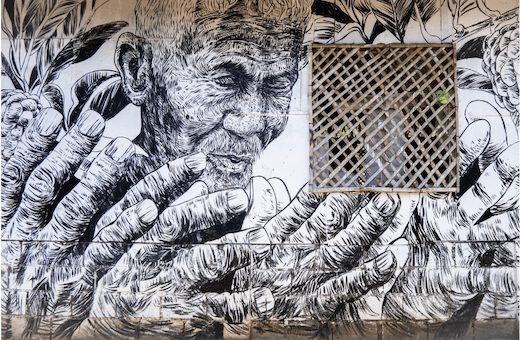 PRAY. A mural of village elder Nelson decorates the outside of the Aeta Learning Center. Photo by Lance Spencer Yu.
Along another outside wall of the learning center is another mural. Aetas stand among lush greenery, soaring mountains, and a bright blue sky. A child holds open a book that reads in Aeta Mag-antsi: “Main pagmi miha ya Ayta.” (The Aeta have unity.)
Off to one side is a curious figure – a pale-skinned woman with white hair. It’s Lisa, the Thai K-pop star from BLACKPINK. How did a K-pop idol come to be painted on the walls of their learning center?
 COMMUNITY. A mural painted outside the learning center shows community members posing in the lush landscape, with BLACKPINK’s Lisa off to one corner.
 It’s all part of a wider story about an Aeta community that lost its home to natural disaster and began to stand up for itself.
‘Kailangan ng mga Aeta ‘yung edukasyon’
It began in the Christmas season of 2021. Volunteers, including the founding members of Liwanag at Dunong, had visited the community for their annual Paskuhan sa Tribo. They wanted to help, but before that, they wanted to listen.
At the time, the community hadn’t fully warmed up to them. Still, when they arrived, one mother, Lily, approached them. When asked what the community might need, her response was simple: “Poste (electric posts).”
This was during the pandemic, when many students were still under the Department of Education’s modular learning program. Without electricity, children struggled to study after dark. Some had gadgets, but nowhere reliable to charge them. At times, they had to go to another area just to find a connection.
The volunteers listened. They also consulted Nelson to understand what kind of help the community wanted. He had a clear answer.
“Ang sabi ko, ‘ang gusto kong tulong ‘yung pangmatagalan na tulong,” he said. “Kung puro relief lang, nakakaraos kami sa binibigay niyong biyaya, pero hindi ‘yun ang kailang ko. ‘Yung kailangan ko talaga ‘yung matuto kami.”
(What I said was, ‘The kind of help we need is help that lasts.’ If all we get are relief goods, then yes, we get by thanks to the blessings you give us, but that’s not what we need. What we really need is to learn.)
“Kailangan ng mga Aeta ‘yung edukasyon (What the Aeta need is education).”
After some deliberation, the volunteers came up with a proposal. Beyond just an electric post, they could build a learning hub in the community, serving as a mini-library and a classroom to hold lessons. It would be solar-powered so that there’d be no monthly electricity bill.
But before moving forward, they wanted to know how the community would receive the idea. Maningning Vilog, Liwanag at Dunong grassroots organizing and advocacy lead, recalled gathering residents and pitching the idea of a learning center.
“Nasanay na ‘yung mga katutubo na maraming nag-didesisyon ng kailangan nila,” she said. “Pero this time, ipapaalam natin ‘yung suggestion. Kapag ayaw nila, hindi natin itutuloy. Kasi sa kanila ‘yun e.”
(Indigenous communities had grown used to other people deciding what they needed. But this time, we’ll ask the community’s permission first. If they don’t like our suggestion, then we won’t push through. It’s theirs, after all.)
The community’s response was one eager question: Where do we put it?
To learn is to defend
Kalangitan is home to around 400 people across Sitio Gayaman and Sitio Bagingan. Many here were resettled after Mount Pintaubo’s eruption in 1991. But so far from their ancestral lands, work is harder to find, and much of what is available is low-paid and insecure.
Worse still, Aetas in the community have faced discrimination and exploitation. Vendors could be cheated out of their change. Residents could be approached by outsiders carrying documents filled with legalese they could not read, told that the papers were for relief goods, only to later find out that they had signed away rights to ancestral lands.
Nelson knew that vulnerability himself. Back in 2013, his ancestral land was caught in the development of what is now New Clark City. He eventually accepted compensation after facing pressure from relatives and the belief that the government would take the land one way or another.
It was a fight that might have been approached differently if he and others in the community had the words and confidence to better assert their rights. To Nelson, literacy was empowerment.
“Sa eleksyon, ‘di kami marunong magsulat kung sinong tao ang gusto namin na iboto. Kaya gusto namin matututong mag-aral. ‘Yan ang punto ko.”
(During elections, we can’t write the name of the person that we want to vote for. That’s why we want to study. That’s my point.)
So it was settled: the learning center would be built in the community, on land owned by Nelson. Even the children were excited; they sketched out plans imagining the learning center surrounded by trees, with a van bringing volunteers to teach.
 COMMERCE. A volunteer teaches Nelson business skills, including how to calculate value-added tax. Photo by Liwanag at Dunong.
Who fears a classroom?
Almost immediately, the project ran into resistance.
Local officials and officials from the National Commission on Indigenous People (NCIP) began to question Nelson. Who suggested starting a school? Calangitan Elementary School already existed farther out in town; why set up another?
Nelson stood his ground. He insisted it was all his idea. And after all, aren’t they free to do as they please? There was no issue with the land; it was his land after all. What was so wrong with letting the Aeta learn?
“Nakausap ko na ‘yung NCIP. Nakausap ko ‘yung assistant ng mayor. Sabi sa akin, ‘ano ba pinagmamatigas mo, Nelson?’ Wala po akong pinagmamatigas.”
(I’ve already spoken to the NCIP. I’ve spoken to the assistant to the mayor. They said, ‘why are you being so stubborn about this, Nelson?’ I’m not.)
“Ang hinihiling ko lang na tulong sa tumutulong sa amin, bilang request, ‘yung edukasyon […] ‘Yung mga tumutulong naman hindi naman sila nangangailangan ng sahod, hindi katulad dito sa public school. Kung wala silang sahod, hindi sila magtulog. Pero dito, volunteer.”
(All I’m asking for us for those who want to help them to help through education. Those helping us aren’t asking for a salary, unlike public school teachers, who won’t teach us if they aren’t paid. Here, they’re volunteers.)
Still, Nelson felt that the officials treated the learning center as something malicious, as if he had to justify the simple act of gathering people to read and write. To him, there was nothing hidden about it. Liwanag at Dunong was a volunteer organization. Its organizers were not paid fixed salaries. It had no large financial backer. Even meals and transportation depended on volunteers chipping in for a budol fight and a jam-packed van.
The village elder couldn’t shake the suspicion that their questions were never really about logistics. They were about whether the Aeta should be allowed to learn outside systems beyond their control.
“Marurunong na kayo. Gusto niyo kami palaging naloloko. Kayo nga, nakapag-aral kayo, kami hindi eh,” he said. “May mga may puso, ‘yung volunteer o ‘yung tutulungan kami sa edukasyon para kami matutong magbasa, magsulat. Ano ‘yung masama doon?”
(You’re already educated. It’s as if you want us to remain easy to fool. You were able to study. We were not. Now, there are volunteers with a heart who want to help us learn to read and write. What’s wrong with that?
 ORIENTATION. A Liwanag at Dunong organizer leads the introductory session of new volunteers. Photo by Lance Spencer Yu.
Even retelling the story to me years later, his voice turned sharper: “Kahit saan ako makarating, paninindigan ko ‘yung sinasabi ko,” he said. “Hindi ako napatilag sa kanila. Patayin niyo na ako kung gusto niyo. Wala akong tinatago. At hindi lang ako ang gustong matuto – marami.”
(No matter where I go, I’ll stand by what I said. They didn’t make me back down. Kill me if you must. I’ve nothing to hide. And I’m not the only one who wants to learn — many of us do.)
What hardened Nelson’s resolve was his own memory of being denied the chance to learn. He grew up during the dictatorship of Ferdinand Marcos Sr., a period he remembers as chaotic and frightening for Aeta communities. Schooling, he said, was difficult to sustain when conflict reached the mountains and indigenous people were treated with suspicion by those in power.
“Hindi po kami nakapag-aral noong bata kami. Dahil magulo ang panahon noon, noong panahon ni Ferdinand Marcos,” he said. “Noong kay Marcos, naraming nag-NPA (New People’s Army) na tao dahil binubog-bog. Gusto ni Marcos, siya ang palaging natutupad, hanggang sa binaba niya ‘yung martial law.”
(We weren’t able to study when we were children because it was a turbulent time during the term of Ferdinand Marcos. Many joined the NPA under Marcos because they were being beaten up. Marcos wanted everyone to obey him until he imposed martial law.)
The New People’s Army (NPA) — the armed wing of the Communist Party of the Philippines and considered a rebel group by the Philippine government — grew rapidly through the ’70s and ’80s under the Marcos dictatorship. As the insurgency took root in the countryside, some indigenous communities found themselves drawn into the conflict, sometimes being caught between government forces, rebels, and the suspicion that followed both.
He also sees echoes of those old horrors in more recent years. Under former president Rodrigo Duterte, he witnessed state violence return — only this time, directed at suspected drug users and pushers.
“Kung paano ang ginawa ni Marcos, ganun din na rin ‘yung kay Digong. ‘Yung kay Digong naman, ‘yung mga drug addict lang,” he said.
(What Marcos did, Duterte did the same — only this time, Digong targeted drug addicts.)
For Nelson, these past traumas and fears explain why he fought for the learning center. Now, under another Marcos presidency, he sees the center as a reminder of education being a tool against oppression.
“Ayaw ko nang mangyari ‘yung ganun. Maraming nabiktima (I don’t want the same to happen. Too many people were victimized).”
A dream built with K-pop
After pushing past questions from local officials and the NCIP, actually building the learning center proved difficult as well.
The community came together to begin the work. Children cleared out the site, pulling out twigs, leaves, and stones. Fathers helped with the construction itself. But getting the materials was harder. Liwanag at Dunong was a small volunteer organization with no external funding, and every piece of the center had to be sourced, donated, or paid for through people pitching in.
“Napakahirap niya. Sa isang maliit na organisasyon na katulad natin, kasi galing pa kaming Maynila, ang hirap nung pagpapatayo talaga,” Vilog said.
(Putting it up was very difficult, especially for a small organization like us, whose volunteers come from Manila.)
The learning center as it stands today is a product of many separate acts of help. The bamboo came from farmers in Barangay Tinang, Tarlac. The doors were donated by the owner of a milktea shop in Mandaluyong city. The shelves that now line the walls, filled with donated books, came from different supporters as well.
One story stands out.
When the foundation had already been cemented and the structure had begun to rise, there was still no money for a roof. The rainy season was approaching. During downpours, the unfinished center would fill with water. Children would swim in the pooled rainwater until their lips turned purple from the cold.
Then during a virtual meeting, as the Liwanag at Dunong team worried over how to raise money for the roof, a local fan group for Lisa of BLACKPINK reached out to the organization’s social media page.
“Habang nasa meeting room, may nag-message doon sa page. Sabi nila: ‘Ano pong kailangan niyo?’ ” Vilog recounted.
(While we were in the meeting room, someone messaged our page. They said: ‘What do you need?’)
The team took the chance. The fan group helped fund the center’s roof and the remaining work on the flooring.
Later, the connection came full circle. When BLACKPINK held a concert in the Philippines in 2023, the Aeta Learning Center appeared on the bottom layer of Lisa’s birthday cake design – the original mural decorating a learning center that had once stood unfinished in the rain.
 CELEBRATION. K-pop star Lisa marks her 26th birthday with a cake featuring the Aeta Learning Center in Gayaman on its bottom layer. Photo from Lisa’s Instagram.
From learner to katutubong guro
Today, the learning center has become one of the community’s gathering points. On Sundays, children come for activities with the volunteers — singing, dancing, drawing. Adults sit through lessons of their own, many treating it as a second chance at something they were denied when they were younger.
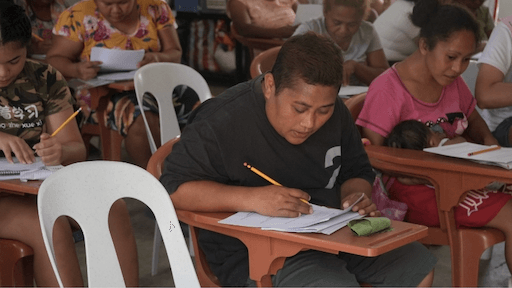 LEARN. Adult learners study at the Aeta Learning Center, a volunteer-run literacy space in Kalangitan, Tarlac. Photo by Liwanag at Dunong.
Minda de la Cruz is one of these older learners. She lives in neighboring Sitio Bagingan, about a 15-minute walk away through a small ravine that turns difficult, even dangerous, during the rainy season.
But life in the community often leaves little room for rest or study, even on Sundays. Instead of attending class, she sometimes has to eke out a livelihood, selling vegetables around the community and in town.
She has watched the land around her change. These days, Tarlac is busy with economic activity. The rise of New Clark City has brought with it golf courses, foreign-partnered developments, and its road and airport network. But for many indigenous people who were displaced from their ancestral lands, the promised opportunities remain out of reach.
This development, it seems, has arrived close to them, but not for them.
“Tulad namin, hindi nag-aral. Hindi naman kami makakapasok diyan sa mga sinasabi nilang Green City na ‘yan dahil hindi naman tatanggapin ang walang inaral,” Minda said.
(People like us, who never had the chance to study, aren’t able to get a job in what they call Green City because those without education won’t be accepted.)
That is why she makes time for the Aeta Learning Center.
(For us to learn, for us to know right from wrong. We want to learn to read and to count so that we’re not cheated by others. For us vendors, we need that.)
At its peak, the program was successful enough that it grew beyond weekend classes. Aside from volunteers who travel to Kalangitan on Sundays, four katutubong guro (indigenous people’s teachers) taught within the community on weekdays.
Neslyn Pelacio is one of them. Having graduated from the Alternative Learning System in 2023, she began to teach others in the community as well. But her lessons go beyond just reading and writing. She is also known in Kalangitan for making bracelets and other small accessories, which she sells for income. But rather than keeping the craft to herself, she has been teaching others how to make them too.
 TEACHER. Neslyn Pelacio, a katutubong guro in the community, joins volunteers to celebrate her birthday before heading off to harvest ginger. Photo by Lance Spencer Yu.
“Tinatanaong nila, paano ka na, hindi ka makakatinda? Sabi ko, huwag niyo akong intindihin. ‘Yung isip ko kasi hindi lang umiikot sa iisang produkto,” Neslyn said.
(Others ask me, what about you, you won’t be able to sell anymore? I told them, don’t worry about me. My mind doesn’t revolve around one product.)
More than the extra income, what mattered to Neslyn was the chance to help others build something more for themselves. Sharing the craft meant another mother could earn, another child could be fed. Knowledge is not diminished when shared.
“Sabi ng isang nanay sakin: ‘Malaking tulong sakin ‘yung naturuan mo akong gumawa ng bracelet. Napangbili ko ng gatas ‘yung anak ko.’ Masaya po sa pakiramdam,” she said. “Hindi ko man siya nabigyan ng pera, pero tinuturo ko sa kanila, ‘yung pera nauubos ‘yan. ‘Yung bigas na binibigay sa’yo, nauubos ‘yan. Pero ‘yung natututunan mo sa isang tao, kahit kailan, hindi na maaalis ‘yan.
(One mother told me: ‘Teaching me how to make bracelets helped me a lot. I was able to buy milk for my child.’ It made me happy. Even if I wasn’t able to give them money, well, I tell them that money runs out anyway. Rice that’s given to them runs out. But what you learn from someone will always stay with you.)
In many ways, that belief is reflective of the philosophy behind the Aeta Learning Center. It’s a place where knowledge flows within the community, from volunteers to learners, from one mother to another, a generation at a time.
Or in Neslyn’s words: “Huwag natin ipagdamot ‘yung mga natutunan natin (Let’s not gatekeep our wisdom).”
But this work is vulnerable to the same pressures that made the learning center necessary in the first place. Many of the katutubong guro, including Neslyn, have struggled to continue teaching regularly because they need to keep working throughout the week.
Then came an unexpected burden: rapidly rising oil prices. Sparked by a war thousands of kilometers away, its effects soon reached this remote community too. – Rappler.com
(The last part of this 3-part series will be published on Wednesday, June 17.)
Lance Spencer Yu is a former business journalist for Rappler. He previously covered how government policies and economic shocks affected vulnerable sectors, including onion farmers and jeepney drivers. He later worked as a private capital analyst at MSCI, and as an investment and strategy analyst at Dedale Intelligence, producing research for private equity funds and institutional investors.
Trisha Concepcion holds a Bachelor of Arts in Literature, major in Literary and Cultural Studies, from De La Salle University. Her experience spans education, cultural work, and research, including work in museum programming and indigenous heritage-related government projects. She has also taught under the Arts and Design Track at De La Salle University Senior High School, handling subjects in research, arts, culture, and literature. She is currently pursuing graduate studies in Anthropology.